Showing posts with label abraham lincoln. Show all posts

Tuesday, June 29, 2010

Lincoln's Brain: Suddenly the bullet dropped out


I first encountered Sarah Vowell through the Daily Show and then in The Incredibles. Finally picked up a copy of Assassination Vacation the other day. Was going to read only the first 20 pages or so and was 51 pages into it before I stopped to make note of the extraordinary passage quoted below.

The above video is an excerpt from a longer talk she gave to promote her book The Wordy Shipmates. She has a rare ability to add humor and charm to subject matter that is usually devoid of both. In the clip, she is discussing the differences between the Geneva Bible and the King James Bible, illustrating this with an anecdote from her youth about how she would put on a puppet show "about how people of faith needed to stand up to wrong-headed kings."

Assassination Vacation is about her pilgrimage around the US to various museums, prisons and historical homes having something to do with presidential assassinations - specifically, those of Lincoln, Garfield and McKinley. The passage below is about Lincoln's brain:

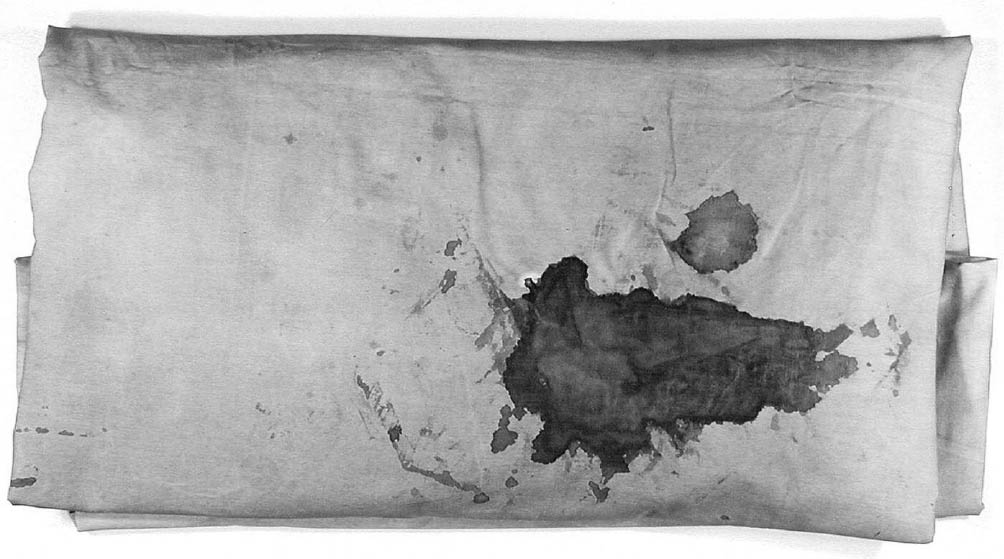
Curtis and Woodward were examining Lincoln's head, looking for the bullet, this bullet now in this museum. Curtis wrote, "Not finding it readily, we proceeded to remove the enture brain."

Think about that. I know I have. For the first few days after I read that, every time I took a five-dollar bill out of my wallet I looked at the engraving of Lincoln's head and couldn't get the image of his detached brain out of my head. Curtis goes on to write that as he was lifting the brain out of the skill, "suddenly the bullet dropped out through my fingers and fell, breaking the solemn silence of the room with its clatter, into an empty basin that was standing beneath." Listen. That room was so quiet. Of course it was. When the bullet dropped in such a quiet room, it must have been almost as jarring as the original gunshot. In less steady hands, the brain could have fumbled to the floor. Curtis stares at that bullet:

"There it lay upon the white china, a little black mass no bigger than the end of my finger - dull, motionless and harmless, yet the cause of such mighty changes in the world's history as we may perhaps never realize.... Silently, in one corner of the room, I prepared the brain for weighing. As I looked at the mass of soft gray and white substance that I was carefully washing, it was impossible to realize that it was that mere clay upon whose workings, but the day before, rested the hopes of the nation. I felt more profoundly impressed than ever with the mystery of that unknown something which may be named "vital spark" as well as anything else, whose absence or presence make all the immeasurable difference between an inert mass of matter owing obedience to no laws but those covering the physical and chemical forces of the universe, and on the other hand, a living brain by whose silent, subtle machinery a world may be ruled. The weighing of the brain... gave approximate results only, since there had been some loss of brain substance, in consequence of the wound, during the hours of life after the shooting. But the figures, as they were, seemed to show that the brain weight was not above the ordinary for a man of Lincoln's size. "


Thursday, December 31, 2009

The Language Cathedral: Biography: Slice Up A Dead Horse As An Example


[ source ]


As can be noted from the entry on Lincoln, I have been exploring the relationship between biography and reality; the structure and function of the mirror the biographer stands before the person.

Years ago, I read every available biography of Orson Welles. I wanted to explore the Wellesian persona in the fragmented, Rashoman-like manner that Citizen Kane circled around the mystery of Kane. The hope was that the multiple reflections would present a more "authentic figure" of Welles than any one alone. Would it be possible to see the man behind the curtain? Through these various perspectives, would I uncover an ontological synecdoche: a single object that stood as final summary, key, to the core of Welles' life, a "rosebud"?


[ source ]


The biography, the life, the being, of a Quixote, a Hamlet, a Kane, is contained within the work, the artifact, the art. It is a sphere that we can stand outside of and look into, a crystal ball upon the teller's table. It is contained, limited (in the strictest sense: described), within the context of our being (although there is argument here - see Bloom). The biographer's task of representation is always beyond, at most, concurrent with his own being. Meditation upon a person reflected in a multitude of mirrors - biographical representations - can perhaps provide a more "holographic" portrait, but the innermost thoughts, the soliloquies of self meaning, remain occluded, shadows under the surface.


[ source ]


There is epistemological tension in this: who or what is represented in words about a man's life? Persona is indicated above - aspects of a mask. Questions fractal along the edge between language and reality. The Mirror of Representation cracks, slivers, melts on the threshold of the the Real, the Noumenon.


[ source ]


It is convenient (and, admittedly, suspect) to set up dialectical positions here: one implicitly affirming the validity of language as an instrument to reflect an accurate image of the World; the other rejecting the accuracy of the representation but still employing the language, oblivious - willfully so - to the implicit implications. Slice a dead horse as example: one holding the Mirror up to the World, believing the reflections to be real; the other attempting the shatter the Mirror to show that what is reflected is a false representation of... what? If not the World, perhaps the Subjective Real. The Mirror remains. Language is always transcendent over its representations.


In Mimesis, Erich Auerbach writes:

As recently as the nineteenth century, and even at the beginning of the twentieth, so much clearly formulable and recognized community of thought and feeling remained in those countries that a writer engaged in representing reality had reliable criteria at hand by which to organize it. At least, within the range of contemporary movements, he could discern certain specific trends; he could delimit opposing attitudes and ways of life with a certain degree of clarity. To be sure, this had long since begun to grow increasingly difficult. Flaubert (to confine ourselves to realistic writers) already suffered from the lack of valid foundations for his work; and the subsequent increasing predeliction for ruthlessly subjectivistic perspectives is another symptom. At the time of the first World War and after - in a Europe unsure of itself, overflowing with unsettled ideologies and ways of life, and pregnant with disaster - certain writers distinguished by instinct and insight find a method which dissolves reality into multiple and multivalent reflections of consciousness. That this method should have been developed at this time is not hard to understand.
But the method is not only a symptom of the confusion and helplessness, not only a mirror of the decline of our world. There is, to be sure, a good deal to be said for such a view. There is all these works  a certain atmosphere of universal doom: especially in Ulysses, with its mocking odi-et-amo hodgepodge of the European tradition, with its blatant and painful cynicism, and its uninterpenetrable symbolism - for even the most painstaking analysis can hardly emerge with anything more than an appreciation of the multiple enmeshment of motifs but with nothing of the purpose and meaning of the work itself. And most of the other novels which employ multiple reflection of consciousness also leave the reader with an impression of hopelessness. There is often something confusing, something hazy about them, something hostile to the reality that they represent. We not infrequently find a turning away from the practical will to live, or delight in portraying it under its most brutal forms. There is a hatred of culture and civilization, brought out by means of the subtlest stylistic devices which culture and civilization have developed, and often a radical and fanatical urge to destroy. [emph. mine]

Auerbach wrote Mimesis in exile from the Third Reich - without access to any of the primary texts. It was published in 1946. You can hear the thunder of the War in his language, the evening light of the "European tradition" pulses within the words. Yet, over half a century later, Joyce's love-hate montage resides within the same canonical zoo as Swift, Milton, Dante and Shakespeare. And whatever the aberrations of Modernism might have been, "the radical and fanatical urges to destroy" there were nothing compared to the Rough Beast that has now slouched into view.


[ source ]


An excerpt from an interview with Slavoj Žižek not long after the events of September 11, 2001:

Has 11 September thrown new light on your diagnosis of what is happening to the world?
Slavoj Žižek: One of the endlessly repeated phrases we heard in recent weeks is that nothing will be the same after 11 September. I wonder if there really is such a substantial change. Certainly, there is change at the level of perception or publicity, but I don't think we can yet speak of some fundamental break. Existing attitudes and fears were confirmed, and what the media were telling us about terrorism has now really happened.
In my work, I place strong emphasis on what is usually referred to as the virtualisation or digitalisation of our environment. We know that 60 percent of the people on this Earth have not even made a phone call in their life. But still, 30 percent of us live in a digitalised universe that is artificially constructed, manipulated and no longer some natural or traditional one. At all levels of our life we seem to live more and more with the thing deprived of its substance. You get beer without alcohol, meat without fat, coffee without caffeine...and even virtual sex without sex.
Virtual reality to me is the climax of this process: you now get reality without reality...or a totally regulated reality. But there is another side to this. Throughout the entire twentieth century, I see a counter-tendency, for which my good philosopher friend Alain Badiou invented a nice name: 'La passion du réel', the passion of the real. That is to say, precisely because the universe in which we live is somehow a universe of dead conventions and artificiality, the only authentic real experience must be some extremely violent, shattering experience. And this we experience as a sense that now we are back in real life.
Do you think that is what we are seeing now?
Slavoj Žižek: I think this may be what defined the twentieth century, which really began with the First World War. We all remember the war reports by Ernst Jünger, in which he praises this eye-to-eye combat experience as the authentic one. Or at the level of sex, the archetypal film of the twentieth century would be Nagisa Oshima's Ai No Corrida (In The Realm Of The Senses), where the idea again is that you become truly radical, and go to the end in a sexual encounter, when you practically torture each other to death. There must be extreme violence for that encounter to be authentic. [emph. mine]

Another emblematic figure in this sense to me is the so-called 'cutter'- a widespread pathological phenomenon in the USA. There are two million of them, mostly women, but also men, who cut themselves with razors. Why? It has nothing to do with masochism or suicide. It's simply that they don't feel real as persons and the idea is: it's only through this pain and when you feel warm blood that you feel reconnected again. So I think that this tension is the background against which one should appreciate the effect of the act.


It has been my project for many years to believe in the language as living thing, as having authentic being. In this manner, I often imagine the requirements for a biography of Language, not as a chronology of facts or historical events, but as a means of penetrating to into the core of Being, of unfolding the mystery. I have, in fact, been obsessed with this of late. This concern has been at the core of me and through all the violence and brutality that I have brought upon it with my attempts at creation and explanation, it has retained its gem-like flame.

From the Letter on Humanism by Heidegger:

Language is the house of Being. In its home man dwells. Those who think and those who create with words are the guardians of this home.


With thanks to Castrovalva's sublime Notes From Underground for links and inspiration.


Wednesday, December 30, 2009

Out of the music and violent dreams of the war, Lincoln stood taller


Amongst the boxes of an inherited library, I uncovered a collection of Lincolnalia - over a dozen biographies and books about Abraham Lincoln - the most recent one published in the 1950s. So I decided to read a handful of them. Perversely, I first went down to the Bellingham Library and checked out what I assumed to the most authoritative and up-to-date biography to start off with, Lincoln by David Donald, published in 1995. Figured that the extra 45 years might offer insightful perspective that I could then carry on into the earlier texts.

From The Library Journal:

Donald's profile of the 16th president focuses entirely on Lincoln, seldom straying from the subject. It looks primarily at what Lincoln "knew, when he knew it, and why he made his decisions." Donald's Lincoln emerges as ambitious, often defeated, tormented by his married life, but with a remarkable capacity for growth into the nation's greatest president. What really stands out in a lively narrative are Lincoln's abilities to hold together a nation of vastly diverse regional interests during the turmoil and tragedy of the Civil War.

At the end of Chapter 9: The Taste Is in My Mouth, just after the moment where Lincoln realizes that he is going to be the next president, I realized there was something, some essential life, poetry, missing from Donald's biography. The research was impeccable, everything presented in fine order, and yet, at this crucial moment in the history of a great man's life, I felt distant and "locked out" - especially in that Donald makes a point in the preface to emphasize that this is "a biography written from Lincoln's point of view, using the information and ideas that were available to him."


So I turned to Carl Sandburg's Abraham Lincoln: The Prairie Years and The War Years, a first edition, no less, published in 1954. I paged around until I found the same place in time at the end of Chapter 14, "Mary, We're Elected." And here, here, was what I was looking for (naturally, coming from a poet). Look at these two examples of the last paragraphs of each book:

Donald:

In the days before the election, as Republican victory seemed increasingly likely, Lincoln's basic pessimism reemerged as he began fully to realize that a campaign initially undertaken primarily for local political reasons was going to place him in the White House. Just a few days before the election he remarked to a New York caller: "I declare to you this morning, General, that for personal considerations I would rather have a term in the Senate - a place in which I would feel more consciously able to discharge the duties required, and where there is more chance to make a reputation, and less danger of losing it - than four years of presidency."

Sandburg:

Events marched and masked their meanings. Facts were gathering motion, whisking into new shapes and disguises every day. Dream shapes of future events danced into sight and out of sight, faded and came again, before a whirlgig of triple mirrors.

I am not sure that I even understand the meaning of Sandburg's language, but I am utterly seduced by it. Whereas, again at this pivotal moment in Lincoln's life, Donald provides us with, what I suspect to be, rather ingenuously humble remark by Lincoln that effectively deflates the moment of all its import.


Amidst the usual masturbatory exaltations of hyperbolic hallmark sentiment that typlifies most of the Amazon.com's customer reviews, I found one from Keith Orth that succinctly concurred:

While I feel that Mr. Donald's sober, respectful portrait of Lincoln reflects serious scholarship, I can't agree that this is the towering literary accomplishment the blurbs suggest. When reading this tome (do you really need such excruciating detail about all those secondary and tertiary 19th century politicians?) one often remembers that the author is an elderly Harvard academic, and not the kind of intuitive storyteller and brilliant writer who is the subject of the book.
To be fair, Lincoln as a man and politician and perhaps our most important president is such a complex proposition that no single volume can do him justice. This is a noble attempt. My only real objection is the author's dryness and lack of narrative propulsion--serious drawbacks at any time but especially taxing in a book this length.


An excellent article in the Journal of Abraham Lincoln Association, Sandburg's Lincoln Within History by James Hurt summarizes the issue beautifully:

A different, though related, charge against The Prairie Years and The War Years is that they contain too much material that is neither biography nor history but merely rather sentimental poeticizing on Sandburg's part. Quaife was as hard on this aspect of The Prairie Years as he was on the careless scholarship. He was especially scornful of what Sandburg called the "moonlight chapters," sections in which he sketched in the historical context of Lincoln's life by imagining what the moon might have seen at the time. "Whatever else it may be," Quaife snorted, it is "not history." Sandburg's "poetical" interpolations were also the butt of Edmund Wilson's famous attack on the book, first in The New Yorker and then in Patriotic Gore. Wilson found Sandburg's treatment of Lincoln's romance with Ann Rutledge particularly hard to stomach. He cited Sandburg's line, "A trembling took his body and dark waves ran through him sometimes when she spoke so simple a thing as, 'The corn is getting high, isn't it?'" Wilson's comment was, "The corn is getting high indeed!"
One critical strategy, faced with the uneasy blend of history and poetry in Sandburg's Lincoln, has been to abandon the claim to biographical accuracy and instead see the book as a large-scale national poem, perhaps an American epic. This is the view taken by, among many others, Penelope Niven, author of the massive and authoritative 1991 Carl Sandburg: A Biography."Abraham Lincoln: The Prairie Years," she writes, "is a vast, epic prose poem, with Lincoln the central figure in the volatile pageant of nineteenth-century American life. A man and a nation simultaneously came of age, for Lincoln grew into manhood as his country faced its own great crisis of character and destiny." It is also essentially the view that Robert W. Johannsen takes in his wonderfully warm and sympathetic 1978 essay on "Sandburg and Lincoln: The Prairie Years." He frames Sandburg as a romantic historian rather than an epic poet, but the two are very similar in Johannsen's formulation. The Prairie Years, he writes, quoting Sandburg approvingly, "was a 'poem of America, the America of humble folk and rough pioneers, of crude settlements ... of the corn lands and broad prairies ... a poem of the human spirit, not Lincoln's spirit only.'"
Sandburg himself saw his book as an American epic as often as he thought of it as a mere biography. In a preface written for The Prairie Years but dropped before publication, he wrote, "The facts and myths of his life are to be an American possession, shared widely over the world, for thousands of years, as the tradition of Knute or Alfred, Laotse or Diogenes, Pericles or Caesar, are kept." And in his "symphonic finish" to The War Years, Sandburg wrote, "Out of the smoke and stench, out of the music and violent dreams of the war, Lincoln stood perhaps taller than any other of the many great heroes. This was in the minds of many. None threw a longer shadow than he. And to him the great hero was The People. He could not say too often that he was merely their instrument." In this and in many similar passages, the figure of Lincoln becomes merged with that of Sandburg's favorite abstraction, The People, and the book becomes a democratic epic celebrating not an individual but a collective hero.

You know that when the primary text gives birth to such electric secondary comment and critique that you are on the right track. When I read, "Quaife snorted, it is 'not history'" and "Wilson's comment was, 'The corn is getting high indeed!'" I laughed out loud.

I imagine that amongst the Homeric Rhapsodes there were Quaifes and Wilsons, sniffing and snorting and arching the supercilious brow. Thousands of years later, the poet stands and Quaife is down in the dust trying to count Hector's teeth. Give me the epic over the Leibowitzian litanies any day.

The other biographies that I have are the sturdy workmanlike "classic" Abraham Lincoln: A Biography by Benjamin Thomas (1954, first edition). And Emil Ludwig's Lincoln (1930, first edition). I won't spend any more time on Thomas except to say that you could still use his text in any high school class without issue. Ludwig is another story. It is important to bear in mind two things: 1. Ludwig was a German, this text being a translation; and, 2. it was published in 1929, 1930. (Also published around this time: All Quiet on the Western Front by Remarque (1929), Heidigger's Being and Time (1927) and Mein Kampf by Hitler (1928). In 1930, the Nazi Party won 107 seats in the Reichstag.)

Ludwig's biography seems, at times, to possess a queer distance from the facts - and not in a poetic Sandburgian manner. He treats Lincoln's life as something divorced from history, counter-real literature, a fine play, with Lincoln as the lead actor. And his writing is soaked in maudlin bathos. A couple of quick quotes:

I see him like one of Shakespeare's characters, absolutely original, comparable to none, immemorable unique.
[...] But then the son fears his father's deathbed just as he had feared his own wedding bed. His loneliness, his great loneliness, makes him dread such encounters and withdraw into himself.

[...] Never again, since Abraham Lincoln lived and died, has an innocent man worn a chain of slavery on his foot on that vast continent.
In the mornings, when my coffee needs a little more saccharine, I tear up pages of the Ludwig biography and stir them into the cup.

So there you have it, over halfway through all four. I was over a Watermark Books in Anacortes the other day and saw the just published Ronald White,  A. Lincoln: A Biography. I figure that I am good for it and, just to make sure the entire cake is covered, Abraham Lincoln by McPherson. I mean, I am already in it, might as well touch bottom.

And yet, over 100 years ago, in 1876,  in his Oration in Memory of Abraham Lincoln, Frederick Douglas said, "Any man can say things that are true of Abraham Lincoln, but no man can say anything that is new of Abraham Lincoln."


The Laughing Bone Store: Abraham Lincoln: The Prairie Years and The War Years by Carl Sandburg