Showing posts with label borges. Show all posts

Tuesday, April 10, 2018

A Conversation with Shelton Walsmith: "Somehow the question keeps the torch lit."


Shelton Walsmith


SC: Again, I'm always in for the more restrained color palette. The Mytho-poetic imagery. I've been reading Book 6 of the Aeneid, the journey of Aeneas into the underworld in search of his father. Just before he died, Seamus Heaney made a translation. Upon finally finding the shade of his father, Aeneas attempts to embrace him:

"Let me take your hand, my father, 

O let me, and do not
Hold back from my embrace.

And as he spoke he wept. 

Three times he tried to reach arms round that neck.

Three times the form, reached for in vain, escaped

Like a breeze between his hands, a dream on wings."


Shelton Walsmith

Shelton Walsmith


SW: I like the pitch of the emotion in that writing. I recently saw Teagle in the play Is God Is? Most of the performance is in a claustrophobic shallow set with a windowed wall close to the front of the stage. Towards the end, Teagle pushes the wall backward and it falls with a crash at a 45 degree angle. He then climbs it to have a showdown with a daughter who's come to kill him. The 4th wall of theater transgressed.

SC: I've been listening to Lee Morgan's Cornbread. It's pure Sunday morning to me.

SW: He managed to infuse those recordings with with joie de vivre.

SC: Overflowing exuberance.

SW: I can turn my frown upside down by simply playing Sidewinder record. Same thing with Django Reinhardt.


Shelton Walsmith


SW: Couldn't find any Lee Morgan at the studio but looking I rediscovered a great by Lee Konitz titled Another Shade of Blue.

SC: I'll check it out. I've always admired how prolific jazz musicians are. Hundreds of albums. The live improvisation and "real presence" of the music being antithetical to closeted perfectionism and hermetic solipsism. 


Shelton Walsmith


SW: Here here. A lot of stuff in the heyday pre-1963 is praying - a very clear transcription of presence. Did you read Giacometti discussing the pursuit of presence? He was all about exposing the ghost and making it playback - recording the playing as it lives -  as you mention. The records of Segovia, Glenn Gould or Kronos Quartet are performance/recorded like jazz live. 

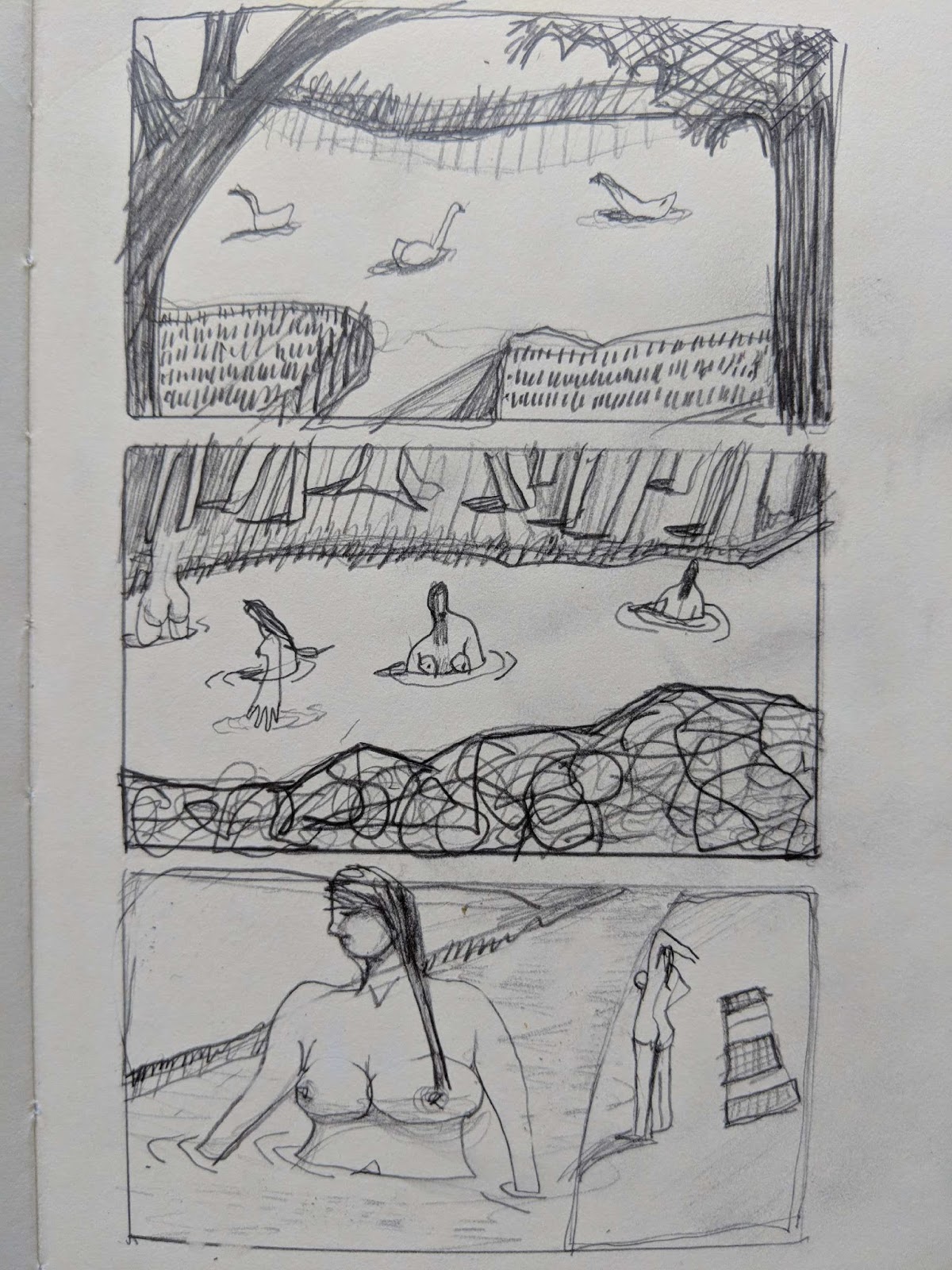
It's been a blessing to take on this bather exhibition. Like you saying, I'm Back! to yourself at the Bellingham library. While I'm drawing studiously daily, I feel most at home. Going through tons of moleskins looking for precedent is a also reminder how much energy and looking and recording I've devoted to drawing. It's an instrument of human thought sounding or touching. It's a lot of rehearsing for painting but it also remains strong as an end to the means.

SC: Not to remark upon a trivial example, but perhaps appropriate for its lack of pretension, I am increasingly aware of how unconsciously practiced and accomplished am I for this work. As if some Mr Miyagi from the Karate Kid has had me painting the fence or waxing the car for years, honing skills I was unaware I possessed. Over 20 years meditation upon a theme, writing poems, songs, prose, creating graphics until is all second nature, like riding a bike. I no longer think about writing: it is an unconscious vehicle to transport me to my destination. I'm pretty happy when I realize this anew. Look ma! No hands!

SW: Exactly.


Shelton Walsmith

Shelton Walsmith

Shelton Walsmith


SC: The immediate provisionality of the sketchbook, the "showing of the work", is always fascinating. Seeing how the sausage is made. Or perfume.


Shelton Walsmith


SC: Sweet.


Shelton Walsmith

Shelton Walsmith

SC: Something in the natural, but muted eroticism of the bathers. Not nude, but just there. The idea of the Venus de Milo in a bikini. It's interesting.

SW: There's something to how open the kimono is...revealing the right amount hiding the best parts. I want to tap into an endless summer atmosphere wherein ghosts are represented as passersby in rivers and lakes and surf. You're always younger when you're swimming and younger is always past. It's a proverbial fish bowl looked on by Prospero. 

SC: Nicely put. Re: Eliot:

Now the hedgerow
Is blanched for an hour with transitory blossom 
Of snow, a bloom more sudden 
Than that of summer, neither budding nor fading, 
Not in the scheme of generation.
Where is the summer, the unimaginable Zero summer?


Shelton Walsmith

Shelton Walsmith


SW: I've continued to study Mark Tansey for his monochromatic mastery and disjointed narrative send offs on sentiment, nostalgia, redacted history and painting about painting. See his "Action paintings"1 and 2. Making grayscale or monochromatic fiction emerges, it's not true to life in it's reduction to tonal over coloristic. My inquiry into how to make it more artificial than lifelike launches a type of Once upon a time...

By grouping them as diptychs or triptychs the additional frame or filmic cell reels another engine of narrative movement


Shelton Walsmith

Shelton Walsmith

SC: Those are excellent. The Muybridge filmic nostalgia.

SW: Like the Disney analogue animation m.o. endless drawings, same but different, not just feeling innocence but also and reanimated call and response btw having it and losing it. Reality vs. recollection. Someone remembered so often their face gets warn off until the memory is grasping as featureless ghosts receding.


Shelton Walsmith


SW: The sexual highlight reel too often revisited goes from lucid real time play by play recollection to blippy gif like compression. Instead of the short film you had now the memory 3 or 4 vignettes flipbooking then it's one long exposure compressed into a single image then  that photograph becomes worn and loses detail to wear and attrition...


Shelton Walsmith

Shelton Walsmith

SC: You are exactly right. Film offers an all too easy metaphor for memory that, while evocative, is not accurate. I think people born in the age of film and now smart phones will think of memory as a message aligned with those mediums: a slow motion panning shot of a walk to the altar, soundtracked with a favorite song, close up on the face, or, far worse, their lives as a series of posed/ not posed filter / no filter selfies. The creative and interpretively demanding windows opened by a work of art with its constantly shifting meanings and aporia are traded for these more compressed representations of the experience - the plastic souvenir remembered instead of the experience itself. The capacities of memory are vast and energized by immersion to the most profound depths. Borges said one of the most signal moments in the development of Western culture was when Aeschylus introduced a second actor onto the stage. No longer a single singer or priest addressing the crowd directly, but a re-presentation of reality, as two actors magically create a dramatic universe we view as non-participatory spectators. No wonder the earliest memory systems were memory theaters. Internal private stages where we each enact our own myths. Something Freud "discovered" as a unexplored country within. 

SW: Isn't interesting that in the first chapter of photography that a negative image needed to be born before it's positive inverse could document the latent image?

A lot of those glass plates that documented Civil War death were destroyed or repurposed as greenhouse windows. It was best forgotten and the photos were a terrible reminder. That reminds me of the Van Gogh scholar researching his haunts and homes discovering a former landlord was using one his paintings traded for rent as the door to her henhouse. The real fate of most pictures rather than d'Orsay, Sotheby's or Hong Kong penthouses.

SC: There is something philosophically and aesthetically beautiful about those images. The eternal question: what is art good for? What does it do? For some, it's a good window, something with which to build a door. Keiffer's monumental leaden books come to mind. But so do the pyramids. And Guernica. 

SW: The use of art or the use of the art encounter is best from the cheap seats in a theatre watching a play. No one's fooling anybody from there and the necessary suspension of disbelief is transferrable into poetry, music and the plastic arts if one needs to ask the question, to what end? Or what use is it?  Suspension of functional practicality. Why take soot or blood and make a handprint or drawing of a bison on the cave wall? To what end? Somehow the question keeps the torch lit. Imaging or reimagining or projecting of mere shadows of the real thing ignites inquiries into the substance of sight and the weight of remembering. Mona Lisa looks at us looking at her and a cycle of wonder loops.

SC: Beautiful. Could my epitaph: 

"To what end? Somehow the question keeps the torch lit. Imaging or reimagining or projecting of mere shadows of the real thing ignites inquiries into the substance of sight and the weight of remembering."

SW: Often progress in art is retrospective like turning your back to the mirror and panning your sightlines back over your shoulder at the view you walking away. Michaelangelo is looking at the ancients and literally thinking, to beat these are guys 

...to beat these guys I need to see  grandeur and monumentality as they saw/projected it. 

Kiefer progressed art by seeing/deposing Nazi hegemony in favor of a pre third Reich Mother Germany. All thru backward visioning. The PreRaphaelite painters pushed into magic realism by genre hopping backward.

SC: Consonant with Borges idea that a writer's awareness of his precursors not only informs his present work, but alters our conception of the past. History is a lie of the mind and as fluid as any story. Thus, he says we now know Homer's Odyssey as coming AFTER Joyce's Ulysses. He cites Whistler's answer to the question of how long it took him to paint one of his nocturnes. Whistler answered, all of my life. "With the same rigor he could have said all the centuries that preceded that moment when he painted were necessary."


Shelton Walsmith


SW: When you answer To what end?  With a political message in visuart at least those aforementioned suspensions become flattened and rigid and to an known end. Political art smells like a doctor's office.

SC: The etymological sense of porno graphia - writing about prostitutes, those who allow themselves to be bought and used for other's purposes. Most of our current culture is pornography to me, more insidious because it tries so desperately to pretend as if it is not. 


Shelton Walsmith


SW: Yeah, we're a mess.

SC: 
Well, I went to the doctor
I said, "I'm feeling kind of rough"
He said, "I'll break it to you, son"
"Let me break it to you, son"
Your shit's fucked up."
I said, "my shit's fucked up?"
Well, I don't see how-"
He said, "The shit that used to work-
It won't work now." - Warren Zevon


Tuesday, May 09, 2017

Give not that which is holy unto the dogs


From the Paris Review: Writ in Water


Jesus, Socrates and the Buddha, never wrote any word that has been preserved.

1 Jesus went unto the Mount of Olives.
2 And early in the morning he came again into the temple, and all the people came unto him; and he sat down, and taught them.
3 And the scribes and Pharisees brought unto him a woman taken in adultery; and when they had set her in the midst,
4 They say unto him, Master, this woman was taken in adultery, in the very act.
5 Now Moses in the law commanded us, that such should be stoned: but what sayest thou?
6 This they said, tempting him, that they might have to accuse him. But Jesus stooped down, and with his finger wrote on the ground, as though he heard them not.
7 So when they continued asking him, he lifted up himself, and said unto them, He that is without sin among you, let him first cast a stone at her.
8 And again he stooped down, and wrote on the ground.
9 And they which heard it, being convicted by their own conscience, went out one by one, beginning at the eldest, even unto the last: and Jesus was left alone, and the woman standing in the midst.

Some claim he wrote the names of all those who were with sin, shaming them. Others that he inscribed into the earth the names of all those who didn't believe. Or that he wrote a single word: Unforgiven. But there is no indication any man ever read the only words ever written down in the dust by Jesus. It's amusing to consider he, like the wily Ulysses, wrote: "No Man," for it illuminates the following exchange with the adulteress:

10 When Jesus had lifted up himself, and saw none but the woman, he said unto her, Woman, where are those thine accusers? hath no man condemned thee?
11 She said, No man, Lord. And Jesus said unto her, Neither do I condemn thee: go, and sin no more.

All of this just antecedent to the book chapter verse of John 3:16 written upon sheets hung over stadium walls where we go to witness violence. Most recently, upon the forehead of a suicide. Unforgiven. No Man.

In the essay, On the Cult of Books, Borges writes:

It is well known that Pythagoras did not write; Gomperz (Griechische Denker I, 3) maintains that it was because he had more faith in the virtues of spoken instruction. More forceful than Pythagoras' mere abstention is Plato's unequivocal testimony. In the Timaeus he stated: "It is an arduous task to discover the maker and father of this universe, and, having discovered him, it is impossible to tell it to all men"; and in the Phaedrus he recounted an Egyptian fable against writing (the practice of which causes people to neglect the exercise of memory and to depend on symbols ), and said that books are like the painted figures "that seem to be alive, but do not answer a word to the questions they are asked." To alleviate or eliminate that difficulty, he created the philosophical dialogue. A teacher selects a pupil, but a book does not select its readers, who may be wicked or stupid; this Platonic mistrust persists in the words of Clement of Alexandria, a man of pagan culture: "The most prudent course is not to write but to learn and teach by word of mouth, because what is written remains" (Stromateis), and in the same treatise: "To write all things in a book is to put a sword in the hands of a child," which derives from the Gospels: "Give not that which is holy unto the dogs, neither cast ye your pearls before swine, lest they trample them under their feet, and turn again and rend you." That sentence is from Jesus, the greatest of the oral teachers, who only once wrote a few words on the ground, and no man read what He had written (John 8:6).

 Following, Plato tellingly writes the words of Socrates in the Phaedrus:

Soc. At the Egyptian city of Naucratis, there was a famous old god, whose name was Theuth; the bird which is called the Ibis is sacred to him, and he was the inventor of many arts, such as arithmetic and calculation and geometry and astronomy and draughts and dice, but his great discovery was the use of letters. Now in those days the god Thamus was the king of the whole country of Egypt; and he dwelt in that great city of Upper Egypt which the Hellenes call Egyptian Thebes, and the god himself is called by them Ammon. To him came Theuth and showed his inventions, desiring that the other Egyptians might be allowed to have the benefit of them; he enumerated them, and Thamus enquired about their several uses, and praised some of them and censured others, as he approved or disapproved of them. It would take a long time to repeat all that Thamus said to Theuth in praise or blame of the various arts. But when they came to letters, This, said Theuth, will make the Egyptians wiser and give them better memories; it is a specific both for the memory and for the wit. Thamus replied: O most ingenious Theuth, the parent or inventor of an art is not always the best judge of the utility or inutility of his own inventions to the users of them. And in this instance, you who are the father of letters, from a paternal love of your own children have been led to attribute to them a quality which they cannot have; for this discovery of yours will create forgetfulness in the learners' souls, because they will not use their memories; they will trust to the external written characters and not remember of themselves. The specific which you have discovered is an aid not to memory, but to reminiscence, and you give your disciples not truth, but only the semblance of truth; they will be hearers of many things and will have learned nothing; they will appear to be omniscient and will generally know nothing; they will be tiresome company, having the show of wisdom without the reality. 

Language dissolving like a castle of sand in the advancing surf. The woven pattern raveling unraveling, reversive, intensive, ambiguous. The word cannot contain the thing :: as the thimble cannot contain the ocean. All acknowledge it stands for, signifies, but is not the thing itself. But a malevolent cogito emerges when spelled out into words: I think, I am but when I write, I am no longer. Every word is a Procrustean Bed wherein my flesh is carved away and limbs hacked off to fit into a dead child's Sunday School suit. I am not so described. The Cloud of Knowing that is my self is a Galaxial Milky Way whirlpool whirling.

"For this discovery of yours will create forgetfulness in the learners' souls, because they will not use their memories; they will trust to the external written characters and not remember of themselves. The specific which you have discovered is an aid not to memory, but to reminiscence, and you give your disciples not truth, but only the semblance of truth."

What testimony will endure of any one of us? What is the meaning of the word written into the dust? Or upon the water? Or upon the stone?


This grave contains all that was Mortal 
of a 
Young English Poet
Who 
on his Death Bed, 
in the Bitterness of his Heart 
at the Malicious Power of his Enemies 
Desired 
these Words to be engraven on his Tomb Stone: 

Here lies One 
Whose Name was writ in Water. 

24 February 1821.


James Henry Breasted copying a hieroglyphic text in the temple of Buhen, Egypt


He pressed the leaves of trees and plants into his book and he stalked tiptoe the mountain butterflies with his shirt out-held in both hands, speaking to them in a low whisper, no curious study himself. Toadvine sat watching him as he made his notations in the ledger, holding the book toward the fire for the light, and he asked him what was his purpose in all this…
Whatever exists, [the Judge] said. Whatever in creation exists without my knowledge exists without my consent.
He looked about at the dark forest in which they were bivouacked. He nodded toward the specimens he’d collected. These anonymous creatures, he said, may seem little or nothing in the world. Yet the smallest crumb can devour us. Any smallest thing beneath yon rock out of men’s knowing. Only nature can enslave man and only when the existence of each last entity is routed out and made to stand naked before him will he be properly suzerain of the earth…
The judge placed his hands on the ground. He looked at his inquisitor. This is my claim, he said. And yet everywhere upon it are pockets of autonomous life. Autonomous. In order for it to be mine nothing must be permitted to occur upon it save by my dispensation.
Toadvine sat with his boots crossed before the fire. No man can acquaint himself with everything on this earth, he said.
The judge tilted his great head. The man who believes that the secrets of the world are forever hidden lives in mystery and fear. Superstition will drag him down. The rain will erode the deeds of his life. But that man who sets himself the task of singling out the thread of order from the tapestry will by the decision alone have taken charge of the world and it is only by such taking charge that he will effect a way to dictate the terms of his own fate. 

- Blood Meridian, Cormac McCarthy 


Monday, December 29, 2014

Mankind had destroyed itself, and the survivors now felt as though they were suicides who had failed.

Eyes That Have Seen the Light of a Thousand Suns
Hiroshima, 1945 - source


This form of pointing to a historicity that can never he fully represented constitutes a kind of allegory in Benjamin's peculiar sense of the term. In Benjamin's understanding, allegory breaks up naturalized concepts of history and life, creating discontinuities through which other times and histories can emerge. Tom Cohen helpfully glosses the term "allography" or "other-writing," describing it as a practice of writing that, like translation, indicates a difference in language that corresponds to history's ongoing and infinitely singular alterity (Ideology 12). Although Borges rejects allegory as
an "aesthetic error," he also acknowledges that it merely exacerbates an abstract aspect of language that is impossible to avoid, even in such forms as the symbol or the novel, which purport to represent immediacy and particularity ("De las alegarias a las novelas," Otras inquisiciones 153-56). If the symbol, the novel, and allegory constitute "maps of the universe," the symbol and the novel are like Borges's famous imperial map that is spread over the colonized territory, and allegory is perhaps the same map, but ill-fitting and shredding with time, perforated by an otherness that it cannot keep covered. Allegory thus concerns a sense of life that cannot be fully represented, but rather gestures beyond itself to what both Benjamin and Borges describe as the "secrets of history" - that is, a conception of history that can never he appropriated by those who Benjamin calls history's victors. - 
- Reading Borges after Benjamin: Allegory, Afterlife, and the Writing of History by Kate Jenckes

In our times, unfortunately, Hirsohima is a forgotten allegory. As such, it has lost contemporary relevance. The word itself has become a metonomy for it's own destruction. Ask almost anyone what Hiroshima means and it will be typically be described as a bombing to end the war with Japan or as the one of the two occurrences in history that nuclear weapons have been used in warfare. What has been forgotten, relegated to the dustbin, is what Benjamin and Borges call the "the secrets of history": what actually happened on the ground to the 350,000 human beings living in the city. 

It has been estimated that 60,000 to 80,000 people were killed instantly - a number that in itself is difficult to imagine. Think of a football stadium filled to capacity - leaving an unsettling margin of error for 20,000 more. If this 20,000 indicated days, it would amount to over 55 years. This is the margin of error. 

In October of 1950, a national survey, counted 158,597 survivors in Hiroshima. Here is where Borges' claim that the allegory is an "aesthetic error" is terribly applicable, for the allegory breaks down in the first person testimonials of life in Hiroshima after the bomb. In the extraordinary case of Hirsoshima, the incomprehensible violent "otherness" of the survivor's traumatic accounts shreds the maps of historiography into obscene fragments disconnected from any meaning. Borges' error has become an imprecation of the highest order, an ontological curse. That we, "history's victors," have become blind to this is indicative of precisely how poisoned by our own "allography," "historiography" we have become. 

On December 10, 1950, William Faulker was awarded the Nobel Prize in Literature. He chose the occasion to deliver these haunting words in his acceptance speech

Our tragedy today is a general and universal physical fear so long sustained by now that we can even bear it. There are no longer problems of the spirit. There is only the question: When will I be blown up? Because of this, the young man or woman writing today has forgotten the problems of the human heart in conflict with itself which alone can make good writing because only that is worth writing about, worth the agony and the sweat. 
He must learn them again. He must teach himself that the basest of all things is to be afraid; and, teaching himself that, forget it forever, leaving no room in his workshop for anything but the old verities and truths of the heart, the old universal truths lacking which any story is ephemeral and doomed - love and honor and pity and pride and compassion and sacrifice. Until he does so, he labors under a curse. He writes not of love but of lust, of defeats in which nobody loses anything of value, of victories without hope and, worst of all, without pity or compassion. His griefs grieve on no universal bones, leaving no scars. He writes not of the heart but of the glands. 
Until he relearns these things, he will write as though he stood among and watched the end of man

27 years later, Arthur Koestler wrote in his book Janus: A Summing Up:

If I were asked to name the most important date in the history of prehistory of the human race, I would answer without hesitation, 6 August 1945. The reason is simple. From the dawn of consciousness until 6 August 1945, man had to live with the prospect of his death as an individual; since the day when the first atomic bomb outshone the sun over Hiroshima, mankind as a while has had to live with the prospect of its extinction as a species.  
We have been taught to accept the transitoriness of personal existence, while taking the potential immortality of the human race for granted. This belief has ceased to be valid. We have to revise our axioms.  
It is not an easy task. There are periods of incubation before a new idea takes hold of the mind; the Copernican doctrine which so radically downgraded man's status in the universe took nearly a century until it penetrated European consciousness. The new downgrading of our species to the status of mortality is even more difficult to digest.  
It actually looks as if the novelty of this outlook had worn off before it had properly sunk in. Already the name Hiroshima has become a historical cliche like the Boston Tea Party. We have returned to a state of pseudo-normality. Only a small minority is conscious of the fact that ever since it unlocked the nuclear Pandora's Box, our species has been living on borrowed time. 

Of course, these days, it is not only destruction by nuclear weapons that poisons our hope, but that of global climate change. It seems that if we do not kill ourselves, the planet will do it for us. And the poisonous effects of digesting this pervasive sense of doom are only just beginning to be seen. All those "old verities and truths of the heart" that Faulkner hoped the next generations might "relearn" are losing all meaning. What remains is only the standing among and watching the end of man.

The journalist Robert Jungk spent three years documenting the post-bomb experience of Hiroshima, recounting many survivors' tales, in City of Ashes: The People of Hiroshima (PDF file). Here are those broken fragments of life in the aftermath. Language, thought itself, seems inadequate in the face of the atrocity. And yet, contra-Faulkner, here at the intimations of what any future "literature" might be.

The M. family also began to show the painful symptoms that revealed the radiation sickness. Setsuo M. complained that his eyesight had suddenly deteriorated, his wife began to lose her hair, while little Hideko vomited several times a day. Kazuo sat for hours each day in front of the entrance that led down to the air-raid shelter and stared out over the vast field of rubble. Later he attempted to recapture his mood as it had been, in a poem that he sent me: 
It rains and rains,
In the slanting rain I sit,
It drums upon my naked skull,
It drips across my singed eyebrows,
It runs into that bleeding hole, my mouth.
Rain on my wounded shoulders,
Rain in my lacerated heart. Rain, rain, rain,
Wherefore do I live on? 
Doctors practising in Hiroshima at that time have recorded that a second phase now set in, after the first period of desperate and confused activity that followed immediately upon the Pikadon; many survivors now gave an impression of utter apathy and showed no wish to go on living. This symptom they called Muyoku-ganbo, and when they noted in a very sick patient's face an expression of listlessness increasing with each passing day, then they knew that there was no longer any hope of saving this particular life. 
An eye-witness, the poetess Yoko Ohta, has described this condition: 'Each of us had for a time done everything possible, without knowing for sure what exactly it was that we were doing. Then we awoke, and now we wished to speak no more. Even the sheepdogs that roamed about ceased to bark. The trees, the plants all that lived seemed numb, without movement or colour. Hiroshima did not somehow resemble a city destroyed by war, but rather a fragment of a world that was ending. Mankind had destroyed itself, and the survivors now felt as though they were suicides who had failed. Thus the "expression of wanting nothing more" came to be seen upon our faces.' 
Children of the Ashes: The People of Hiroshima, Robert Jungk

Where to go from here? What follows the end of what is sayable? What is the future of hope? Obviously, without a future, there is no hope. The language either has to disconnect itself from the stark sheer face of the reality it barely clings to or lose itself in counter-truths, allegorical lies and fantastical maps that reference only imaginary worlds. Perhaps, we are already in the thick of it. Opium dreamers lost in the layers of deeper dreams and false awakening. Much of our media, especially film, is creating fictional critique of this view. If this is the case, the concern is not so much how to escape but why. What incentive is there to fully awaken from the beautiful dream into the horrible reality? Perhaps, there are potentialities for renewal. But these thoughts are plagued by doubt.

It is not that everything is a lie but the space for exodus is narrow, and we find it difficult to sense much of a navigable entanglement of humanity and world. Kafka's insistence that there is an abundance of hope but none for us seems only all the more pertinent to current conditions. [...]
Bloch's most interesting and challenging claim in relation to hope is that it involves danger and fundamental insecurity and that this is its dark ambivalence. At its most difficult, it approaches and resides in a zero-point of emptiness and darkness. But this is a place where fear creates yearning and longing against that which the darkness most obscures and depreciates. The tenebrous realities of death and tragic being can provide a motivating uncertainty in which a renewal might occur. 
- Frances Daly, The Privatization of Hope: Ernst Bloch and the Future of Utopia, edited by Peter Thompson, Slavoj Zizek

These men must today rear their sons and create their works in a world threatened by nuclear destruction. Nobody, I think, can ask them to be optimists. And I even think that we should understand - without ceasing to fight it - the error of those who in an excess of despair have asserted their right to dishonour and have rushed into the nihilism of the era. But the fact remains that most of us, in my country and in Europe, have refused this nihilism and have engaged upon a quest for legitimacy. They have had to forge for themselves an art of living in times of catastrophe in order to be born a second time and to fight openly against the instinct of death at work in our history. 
- Albert Camus, Nobel Prize Acceptance Speech, 1957

Friday, February 07, 2014

11 Translations of "Ballade de bonne doctrine à ceux de mauvaise vie" By François Villon


source

The French poet, François Villon, was born in Paris in 1431 - the same year that Joan of Arc was burned at the stake - then disappeared, never to be heard from again, after 1463. He had lived a hard 32 years as a murderer, thief, outlaw, vagabond, but most of all as a poet. He wrote his most enduring and famous work, Le Grand Testement, in 1461, aged 30. It is a complex collection of ballads and rondels laced through with a macabre humor and aching death-haunted nostalgia. 

One of the more popular ballads, mostly due a translation / rendering by William Ernest Henley in 1887, is from Le Grand Testement, known as the "Ballade de de bonne doctrine à ceux de mauvaise vie." Henley's rendition employs the rich cryptolect canting lingo of thieves commonly spoken in 19th century England. The idea was to replicate the more visceral qualities of Villon's original French with it's in-jokes and slang that we are too linguistically distant from to understand.

Henley's translation, which he titled, Straight Tip to All Cross Cove, took on a life of it's own. In 1911, Andrew Lang remarked that "[Henley's] translations of two of Villon's ballades into modern thieves' slang were marvels of dexterity.” As might be expected, it angered the more "traditional" translators. In 1917, Henry De Vere Stacpoole, a well-known translator of Villon had this to say about Henley:

“This fine ballade is among the best that Villon ever wrote. It has a swing and go absolutely lost in the absurd travesty of it which W. E. Henley published under the name of a translation.  
The man who could render the ringing “Tout aux taverns at aux files” by “Booze and blowers cop the lot” did more than miss the music of the original, he missed the mind of the poet and the method and manner of the writer. 
Villon knew the worth and the worthlessness of slang and argot - none better; and to represent the poet as speaking in the language of a pot-house when he is speaking his own tongue is to misrepresent him.”

More recently, Douglas Hofstadter, in his book concerning translation, Le Ton Beau De Marot: In Praise Of The Music Of Language, discusses Henley's Straight Tip to All Cross Cove as an instance of the difficulty / beauty of translating highly idiomatic texts.

The magician and historian Ricky Jay has recited Straight Tip in his performances.

And the internet is replete with websites offering gloss and commentary on this remarkable translation.


In his Norton Lectures, Borges famously said that "The original is unfaithful to the translation." And Sergio Waisman in Borges and Translation: The Irreverence of the Periphery writes:

The idea that the original can be unfaithful to its translation goes even further than the challenges to fidelity that Borges expresses in "Los traductores de Las 1001 Noches." There, Borges valorizes mistranslations and creative infidelities and suggests that a translation can surpass the original. 

Henley's Straight Tip to All Cross Cove appears to me to a particularly apt instance of this  observation. 

Given that Henley is idiosyncratically definitive, it is still enlightening to read other translations. I have collected a small selection here. Each has their merit and, for anyone who is not proficient in 15th century French, each new translation offers further insight into Villon’s ballad.

I have attributed and linked each translation to the best of my ability. If you are one of the translators and wish me to remove your version, please send me a note in the comments. 

Robert Peckham's Francois Villon. A Bibliography, 1990 is the most comprehensive source. Out of Print and unavailable online.

Please see The Memory Cathedral: Francois Villon for a detailed study of the poem and instruction for memorization. 


source


- More or Less Chronologically Ordered - 


Straight Tip To All Cross Coves, 1887
(De bonne doctrine a ceux de mauvaise vie)
Rendered by William Ernest Henley (1849 - 1903)

 ‘Tout aux tavernes et aux filles’

I

Suppose you screeve, or go cheap-jack?
Or fake the broads? or fig a nag?
Or thimble-rig? or knap a yack?
Or pitch a snide? or smash a rag?
Suppose you duff? or nose and lag?
Or get the straight, and land your pot?
How do you melt the multy swag?
Booze and the blowens cop the lot.

II

Fiddle, or fence, or mace, or mack;
Or moskeneer, or flash the drag;
Dead-lurk a crib, or do a crack;
Pad with a slang, or chuck a fag;
Bonnet, or tout, or mump and gag;
Rattle the tats, or mark the spot
You cannot bank a single stag:
Booze and the blowens cop the lot.

III

Suppose you try a different tack,
And on the square you flash your flag?
At penny-a-lining make your whack,
Or with the mummers mug and gag?
For nix, for nix the dibbs you bag
At any graft, no matter what!
Your merry goblins soon stravag:
Booze and the blowens cop the lot.

The Moral.

It’s up-the-spout and Charley-Wag
With wipes and tickers and what not!
Until the squeezer nips your scrag,
 Booze and the blowens cop the lot.


Villon’s Ballade of Good Counsel, To His Friends of Evil Life, 1911
From Ballads in Blue China and Verses and Translations
by Andrew Lang
[ Check for OCR errors. ]


Nay, be you pardoner or cheat,
Or cogger keen, or mumper shy,
You'll burn your fingers at the feat,
And howl like other folks that fry.
All evil folks that love a lie!
And where goes gain that greed amasses,
By wile, and trick, and thievery?
'Tis all to taverns and to lasses!

Rhyme, rail, dance, play the cymbals sweet,
With game, and shame, and jollity,
Go jigging through the field and street,
With MYST'RY and MORALITY;
Win gold at GLEEK and that will fly,
Where all you gain at PASSAGE passes,
And that's? You know as well as I,
'Tis all to taverns and to lasses!

Nay, forth from all such filth retreat,
Go delve and ditch, in wet or dry,
Turn groom, give horse and mule their meat,
If you've no clerkly skill to ply;
You'll gain enough, with husbandry,
But sow hempseed and such wild grasses,
And where goes all you take thereby?
'Tis all to taverns and to lasses!

ENVOY.

Your clothes, your hose, your broidery,
Your linen that the snow surpasses,
Or ere they're worn, off, off they fly,
'Tis all to taverns and to lasses!

On Henley: 

“The ballade was an old French form of verse, in France revived by
Theodore de Banville, and restored to an England which had long
forgotten the Middle Ages, by my friends Mr. Austin Dobson and Mr.
Edmund Gosse. They, so far as I can trust my memory, were the first
to reintroduce these pleasant old French nugae, while an anonymous
author let loose upon the town a whole winged flock of ballades of
amazing dexterity. This unknown balladist was Mr. Henley; perhaps
he was the first Englishman who ever burst into a double ballade,
and his translations of two of Villon's ballades into modern
thieves' slang were marvels of dexterity.”


Ballad of Good Doctrine To Those of Evil Life, 1914
By Henry De Vere Stacpoole (1863 - 1951)

Ye who be smugglers of papal bulls,
Or cheaters at dice, whatever be ye --
Coiners who risk life and limb like fools,
Then boil in hot oil for their felony,
Traitors disloyal -- ye know who ye be --
Stealers of jewels, of perfume and pearls:
So where goes it all, that ye get in fee?
All to the taverns and to the girls.

Rhyming and jesting, cymbals and lutes --
Don ye these emblems of minstrelsy.
Farce and imbroglio, music of flutes --
Try these in hamlets or Gay Paree.
Go mumming in masque or mystery,
Win money at cards, or at ninepin hurls.
But 'tis of no use1 It'll flow, hear ye me,
All to the taverns and to the girls.

Ye shrink before such a hard-knocks school --
Play safe, then, with honester husbandry:
Of horses be grooms, go tend to a mule,
Plow ye the fields, here and there plant a tree.
And should ye be short on Latinity,
As lowly in learning as poor pleasant churls,
Just work, lest your hard-earned pennies flee
All to the taverns and to the girls.

Envoi:

Your stockings and doublets, your fine drapery,
Every last rag that around ye furls,
Ere ye be done, will have slipped, ye shall see,
All to the taverns and to the girls.


Ballad of Good Doctrine to Those of Evil Life, 1917
From Francois Villon, his life and time, 1431-1463
By Henry De Vere Stacpoole (1863 - 1951)

Be ye carriers of bulls,
Cheats at dice - whate’er ye be,
Coiners - they who risk like fools,
Boiling for their felony.
Traitors perverse - so be ye -
Thieves of gold, or virgin’s pearls,
Where goes what ye get in fee?
All on taverns and on girls.

Song, jest, cymbals, lutes -
Don these signs of minstrelsy.
Farce, imbroglio, play of flutes,
Make in hamlet or city.
Gain at cards, or ninepins hurls.
All your profits, where go they?
All on taverns and on girls.

Turn, before your spirit cools,
To more honest husbandry;
Grooms of horses be, or mules,
Plough the fields and plant the tree.
If you’ve no Latinity.
No more learning than the curls,
Work - nor cast you money free
All on taverns and on girls.

ENVOI

Stockings, pourpoint, drapery,
Every rag that round you furls, 
Ere you’ve done, will go, you’ll see.
All on taverns and on girls.

On Henley:

“This fine ballade is among the best that Villon ever wrote. It has a swing and go absolutely lost in the absurd travesty of it which W. E. Henley published under the name of a translation.

The man who could render the ringing “Tout aux taverns at aux files” by “Booze and blowers cop the lot” did more than miss the music of the original, he missed the mind of the poet and the method and manner of the writer. 

Villon knew the worth and the worthlessness of slang and argot - none better; and to represent the poet as speaking in the language of a pot-house when he is speaking his own tongue is to misrepresent him.”


Ballad of Good Doctrine to Those of Ill Life
By John Payne

SMUGGLE indulgences, as you may: 
Cog the dice for your cheating throws.
Try if counterfeit coin will pay,
At the risk of losing your ears and nose :
Deal but in treason, lie and glose,
Rob and ravish : what profits it ?
Where do you think the money goes ?
Taverns and wenches, every whit.

Flute and juggle and cymbals play :
Follow the mountebanks and their shows :
Along with the strolling players stray,
That wander whither God onlv knows :
Act mysteries, farces, imbroglios :
Gain money by cards or a lucky hit
At the pins : however if s got, it goes :
Taverns and wenches, every whit.

Turn from your evil courses, I pray.
That smell so foul in a decent nose :
Earn your bread in some honest way.
If you have no letters, nor verse nor prose,
Plough or groom horses for food and clothes.
Enough shall you have if you stick to it:
But throw not your wage to each wind that blows :
Taverns and wenches, every whit.

ENVOI.

Doublets, pourpoints and silken hose,
Gowns and linen, woven or knit,
Ere your wede's worn, away it goes :
Taverns and wenches, every whit.


A Bug in the Ear to All Children of Darkness
By Peter Dale

Whether you counterfeit your brass
and end so oiled you boil and bake;
traitors whose credit wouldn't pass;
or peddle pardons; learn to shake
the loaded dice; or maybe take
to filching in and out of doors - 
where does it go, the money you make?
All to the taverns and the whores.

Rhyme or rail or clash your brass,
like shameless fools that always fake;
mime, mum, or try some magic pass;
or if in towns and cities, make
miracles, mysteries, jigs; or take
a trick or two or skittle scores - 
soon gained, soon gone! (You still awake?)
All to the taverns and the whores.

If depths like these are not your class,
then plough up fields or drive a rake;
or turn to doctoring horse and ass.
But only if you cannot take
to book and pen. A crust you'll make.
Yet if you've slaved at prison chores
you haven't lifted loot to take
all to the taverns and the whores.

Envoi 

Before you do much worse then, take
trousers and shoes and all that's yours,
gowns and the silks for your own sake
all to the taverns and the whores.


All to the girls and taverners, 2004
By Stephen Eridan
From The Testament by Francois Villon with facing Notes
Metric translation with altered rhyme scheme


Whether you trade indulgences ,
Play false at bones, counterfeit coin,
Stack the cards, for connivances
Men are boiled, that's the crowd you’ll join,
Or the traitors and heretics,
Whether rapists, thieves, cozeners,
Where goes the booty from these tricks?
All to the girls and taverners.

Play cymbal, rhyme and pluck the lute,
Acting like some dopey mummer,
Do sleight of hand and blow the flute,
In cities and towns each summer,
Stage acts, farces, moralities,
Cards or ninepins, come up winners,
It goes real quick, now hear me please,
All to the girls and taverners.

Hey, don't waste your life with such fools,
Till the fields as long as there's light,
Brush and tend the horses and mules,
Even if you can't read or write,
You can do alright with some care,
But if you keep cutting corners,
Won't you just fork over your share,
All to the girls and taverners.

Pants , laced doublets and softest hose,
Also your best leathers and furs ,
Before you do worse just take those,
All to the girls and taverners.


"Good Doctrines for a Bad Life”, 2004
By Scriblerus

For whether you carry bulls
Or cheat or play dice,
Counterfeiting you burn yourself;
Like those who are emboldened,
Perjurious traitors, empty of faith;         5
Be a thief, steal or pillage:
Where does the booty go, to what end?
All to the taverns and to the girls.

Rhyme, mock, disturb, wrestle,
Like a madman or a shameless crook,         10
Con, embezzle, draw your sword;
Do, in towns and cities,
Tricks, games and parlor games;
Win at the berlanc, the glic or bowling,
It all goes--and listen--                   15
All to the taverns and to the girls.

Walk away from such garbage;
Get a hoe, labour in fields and meadows;
Care for and saddle horses and mules;
You are a blessed ignorant;                 20
You will have enough, I guarantee.
But whether you plough or till your field,
You only labour for one thing
All to the taverns and to the girls.

THE MESSAGE    

Shoes, embroidered pourpoints,              25
Dresses, and all your clothes,
So it doesn't get worse, carry them
All to the taverns and to the girls.


A Good Doctrine for a Bad Life
By Jack Rusher

Whether you smuggle papal bulls,
Or hazard a cheat while playing dice,
Or burn yourself shaping fake coins,
Like those who’re boiled in oil for their felonies.
Perjurious traitors; empty of faith;
Stealing jewels, perfume and pearls,
Where do your winnings go?
All to the taverns and the girls.

Rhyme, rail, crash or fight,
Like a fool or a shameless tout,
Bullshit and battle, or play the flute.
Do, in towns and cities,
Play farces, games and masquerades,
Win at cards or ninepins.
It all goes — and listen —
All to the taverns and the girls.

From this stink you recoil?
Then work hard in fields and meadows,
Turn your thoughts to horses and mules.
If you lack an education,
You’ll still have enough coin.
But whether you plough or till your fields,
Your labor and your work:
All to the taverns and the girls.

The Message

Shoes, embroidered doublets,
Dresses, and all your drapes:
Before you do worse, just carry them
All to the taverns and the girls.


Ballade: A Good Lesson for Bad Men
from The Testament, lines 1692–1719
By David Georgi


Say you sell indulgences
or cheat at cards, or dice all day,
or stamp false coins (and so get burned
with others scalded for that crime,
lying faithless traitors all),
or burgle, pilfer, or purloin:
where do you suppose your profit goes?
All to the taverns and the girls.

Rhyme or riff, play flute or cymbals
as beguiling, shameless fools do;
clown, swindle, con, do magic tricks,
or stage in every town and city
farces, dramas, morality plays;
win at poker, craps, or ninepins—
however it comes, you know it goes
all to the taverns and the girls.

Perhaps such vices make you shudder?
So work! Mow fields and meadows,
groom horses or look after mules
if you lack an education:
you’ll have enough, you’ll be content!
But after you scutch and strip your hemp,
still, don’t you take your meager share
all to the taverns and the girls?

Your hose, your clothes, your lace-up vests,
your robes and haberdashery—
before you go do worse, just take it
all to the taverns and the girls.


Booze and Bitches Just Fuck You Up, 2014
By Scot Casey

Say you palm off communion plates,
Say you play and cheat at bones,
Print out bills til you get burned,
Scarred and scammed like all the others,
All of them fuckers, none of them true,
When you're the man who does the work.
What do you get from all of this shit?
Booze and Bitches just fuck you up.

Sing it say it bang or bash,
Fucking loser, drunken fool,
Fake it, break it, take all the cash.
Bright big city, piece of shit town,
Run your con and all your games:
Cards or drugs or whatever's rough.
I tell you this: You gonna always lose
Cause Booze and Bitches just fuck you up

Say you think your sick of this shit?
Go work for the man in the government:
Kiss the horse's ass and the pig's soft dick.
You are such a fucking idiot.
So sit back now and just rest your bones,
You'll never be able to work enough.
Cause you know your shit will always go
To Booze and Bitches who fuck you up.

You still got your shoes on your feet,
Shirt on your back, your bones and blood,
That's all your ever gonna need

For Booze and Bitches to fuck you up.


Please see The Memory Cathedral: Francois Villon for a detailed study of the poem and instruction for memorization.