 |
| Shelton Walsmith |
SC: Again, I'm always in for the more restrained color palette. The Mytho-poetic imagery. I've been reading Book 6 of the Aeneid, the journey of Aeneas into the underworld in search of his father. Just before he died, Seamus Heaney made a translation. Upon finally finding the shade of his father, Aeneas attempts to embrace him:
"Let me take your hand, my father,
O let me, and do not
Hold back from my embrace.
And as he spoke he wept.
Three times he tried to reach arms round that neck.
Three times the form, reached for in vain, escaped
Like a breeze between his hands, a dream on wings."
 |
| Shelton Walsmith |
 |
| Shelton Walsmith |
SW: I like the pitch of the emotion in that writing. I recently saw Teagle in the play Is God Is? Most of the performance is in a claustrophobic shallow set with a windowed wall close to the front of the stage. Towards the end, Teagle pushes the wall backward and it falls with a crash at a 45 degree angle. He then climbs it to have a showdown with a daughter who's come to kill him. The 4th wall of theater transgressed.
SC: I've been listening to Lee Morgan's Cornbread. It's pure Sunday morning to me.
SW: He managed to infuse those recordings with with joie de vivre.
SC: Overflowing exuberance.
SW: I can turn my frown upside down by simply playing Sidewinder record. Same thing with Django Reinhardt.
 |
| Shelton Walsmith |
SW: Couldn't find any Lee Morgan at the studio but looking I rediscovered a great by Lee Konitz titled Another Shade of Blue.
SC: I'll check it out. I've always admired how prolific jazz musicians are. Hundreds of albums. The live improvisation and "real presence" of the music being antithetical to closeted perfectionism and hermetic solipsism.
 |
| Shelton Walsmith |
SW: Here here. A lot of stuff in the heyday pre-1963 is praying - a very clear transcription of presence. Did you read Giacometti discussing the pursuit of presence? He was all about exposing the ghost and making it playback - recording the playing as it lives - as you mention. The records of Segovia, Glenn Gould or Kronos Quartet are performance/recorded like jazz live.
It's been a blessing to take on this bather exhibition. Like you saying, I'm Back! to yourself at the Bellingham library. While I'm drawing studiously daily, I feel most at home. Going through tons of moleskins looking for precedent is a also reminder how much energy and looking and recording I've devoted to drawing. It's an instrument of human thought sounding or touching. It's a lot of rehearsing for painting but it also remains strong as an end to the means.
SC: Not to remark upon a trivial example, but perhaps appropriate for its lack of pretension, I am increasingly aware of how unconsciously practiced and accomplished am I for this work. As if some Mr Miyagi from the Karate Kid has had me painting the fence or waxing the car for years, honing skills I was unaware I possessed. Over 20 years meditation upon a theme, writing poems, songs, prose, creating graphics until is all second nature, like riding a bike. I no longer think about writing: it is an unconscious vehicle to transport me to my destination. I'm pretty happy when I realize this anew. Look ma! No hands!
SW: Exactly.
 |
| Shelton Walsmith |
 |
| Shelton Walsmith |
 |
| Shelton Walsmith |
SC: The immediate provisionality of the sketchbook, the "showing of the work", is always fascinating. Seeing how the sausage is made. Or perfume.
 |
| Shelton Walsmith |
SC: Sweet.
 |
| Shelton Walsmith |
 |
| Shelton Walsmith |
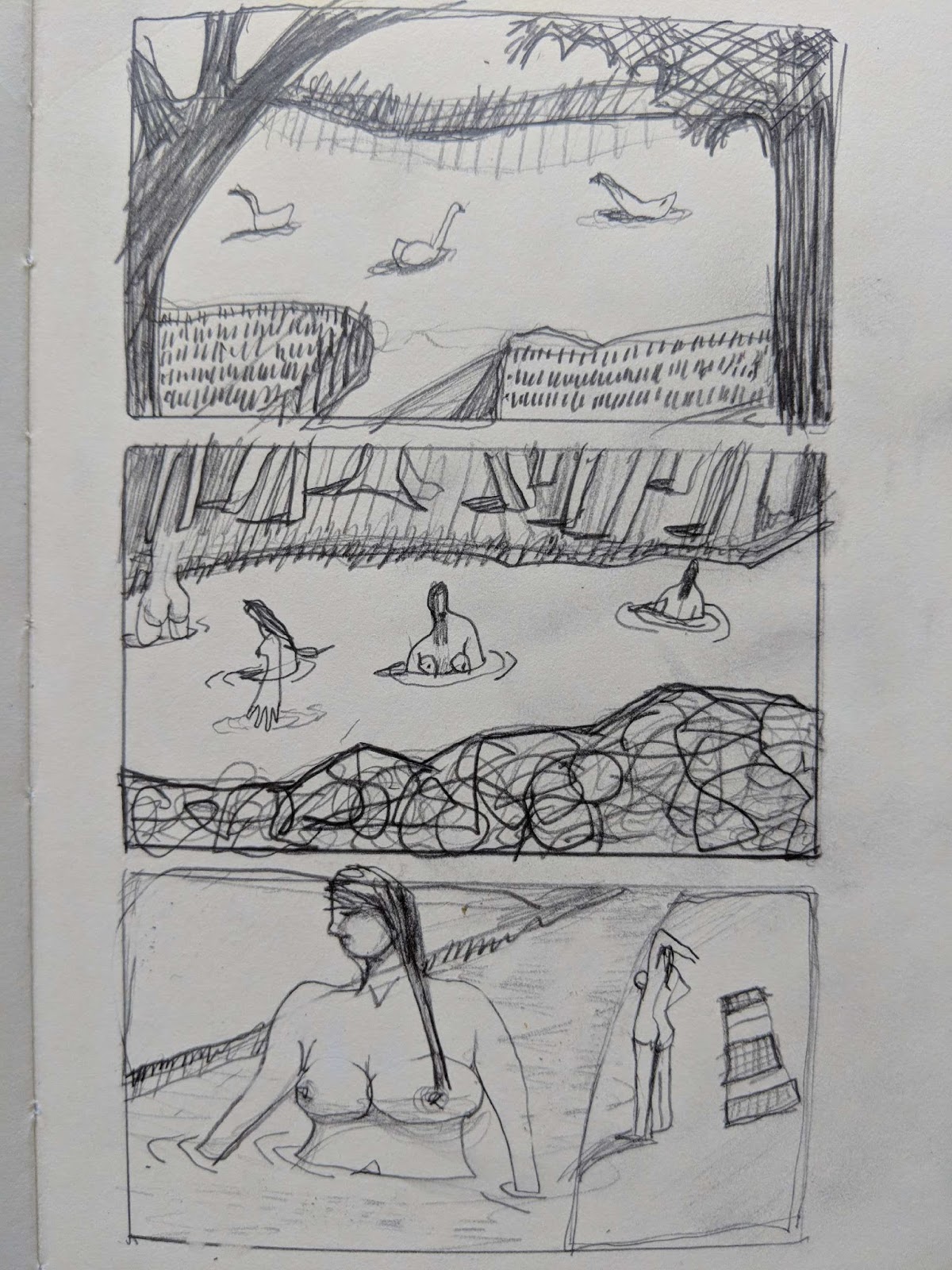
SC: Something in the natural, but muted eroticism of the bathers. Not nude, but just there. The idea of the Venus de Milo in a bikini. It's interesting.
SW: There's something to how open the kimono is...revealing the right amount hiding the best parts. I want to tap into an endless summer atmosphere wherein ghosts are represented as passersby in rivers and lakes and surf. You're always younger when you're swimming and younger is always past. It's a proverbial fish bowl looked on by Prospero.
SC: Nicely put. Re: Eliot:
Now the hedgerow
Is blanched for an hour with transitory blossom
Of snow, a bloom more sudden
Than that of summer, neither budding nor fading,
Not in the scheme of generation.
Where is the summer, the unimaginable Zero summer?
 |
| Shelton Walsmith |
 |
| Shelton Walsmith |
SW: I've continued to study Mark Tansey for his monochromatic mastery and disjointed narrative send offs on sentiment, nostalgia, redacted history and painting about painting. See his "Action paintings"1 and 2. Making grayscale or monochromatic fiction emerges, it's not true to life in it's reduction to tonal over coloristic. My inquiry into how to make it more artificial than lifelike launches a type of Once upon a time...
By grouping them as diptychs or triptychs the additional frame or filmic cell reels another engine of narrative movement
 |
| Shelton Walsmith |
 |
| Shelton Walsmith |
SC: Those are excellent. The Muybridge filmic nostalgia.
SW: Like the Disney analogue animation m.o. endless drawings, same but different, not just feeling innocence but also and reanimated call and response btw having it and losing it. Reality vs. recollection. Someone remembered so often their face gets warn off until the memory is grasping as featureless ghosts receding.
 |
| Shelton Walsmith |
SW: The sexual highlight reel too often revisited goes from lucid real time play by play recollection to blippy gif like compression. Instead of the short film you had now the memory 3 or 4 vignettes flipbooking then it's one long exposure compressed into a single image then that photograph becomes worn and loses detail to wear and attrition...
 |
| Shelton Walsmith |
 |
| Shelton Walsmith |
SC: You are exactly right. Film offers an all too easy metaphor for memory that, while evocative, is not accurate. I think people born in the age of film and now smart phones will think of memory as a message aligned with those mediums: a slow motion panning shot of a walk to the altar, soundtracked with a favorite song, close up on the face, or, far worse, their lives as a series of posed/ not posed filter / no filter selfies. The creative and interpretively demanding windows opened by a work of art with its constantly shifting meanings and aporia are traded for these more compressed representations of the experience - the plastic souvenir remembered instead of the experience itself. The capacities of memory are vast and energized by immersion to the most profound depths. Borges said one of the most signal moments in the development of Western culture was when Aeschylus introduced a second actor onto the stage. No longer a single singer or priest addressing the crowd directly, but a re-presentation of reality, as two actors magically create a dramatic universe we view as non-participatory spectators. No wonder the earliest memory systems were memory theaters. Internal private stages where we each enact our own myths. Something Freud "discovered" as a unexplored country within.
SW: Isn't interesting that in the first chapter of photography that a negative image needed to be born before it's positive inverse could document the latent image?
A lot of those glass plates that documented Civil War death were destroyed or repurposed as greenhouse windows. It was best forgotten and the photos were a terrible reminder. That reminds me of the Van Gogh scholar researching his haunts and homes discovering a former landlord was using one his paintings traded for rent as the door to her henhouse. The real fate of most pictures rather than d'Orsay, Sotheby's or Hong Kong penthouses.
SC: There is something philosophically and aesthetically beautiful about those images. The eternal question: what is art good for? What does it do? For some, it's a good window, something with which to build a door. Keiffer's monumental leaden books come to mind. But so do the pyramids. And Guernica.
SW: The use of art or the use of the art encounter is best from the cheap seats in a theatre watching a play. No one's fooling anybody from there and the necessary suspension of disbelief is transferrable into poetry, music and the plastic arts if one needs to ask the question, to what end? Or what use is it? Suspension of functional practicality. Why take soot or blood and make a handprint or drawing of a bison on the cave wall? To what end? Somehow the question keeps the torch lit. Imaging or reimagining or projecting of mere shadows of the real thing ignites inquiries into the substance of sight and the weight of remembering. Mona Lisa looks at us looking at her and a cycle of wonder loops.
SC: Beautiful. Could my epitaph:
"To what end? Somehow the question keeps the torch lit. Imaging or reimagining or projecting of mere shadows of the real thing ignites inquiries into the substance of sight and the weight of remembering."
SW: Often progress in art is retrospective like turning your back to the mirror and panning your sightlines back over your shoulder at the view you walking away. Michaelangelo is looking at the ancients and literally thinking, to beat these are guys
...to beat these guys I need to see grandeur and monumentality as they saw/projected it.
Kiefer progressed art by seeing/deposing Nazi hegemony in favor of a pre third Reich Mother Germany. All thru backward visioning. The PreRaphaelite painters pushed into magic realism by genre hopping backward.
SC: Consonant with Borges idea that a writer's awareness of his precursors not only informs his present work, but alters our conception of the past. History is a lie of the mind and as fluid as any story. Thus, he says we now know Homer's Odyssey as coming AFTER Joyce's Ulysses. He cites Whistler's answer to the question of how long it took him to paint one of his nocturnes. Whistler answered, all of my life. "With the same rigor he could have said all the centuries that preceded that moment when he painted were necessary."
 |
| Shelton Walsmith |
SW: When you answer To what end? With a political message in visuart at least those aforementioned suspensions become flattened and rigid and to an known end. Political art smells like a doctor's office.
SC: The etymological sense of porno graphia - writing about prostitutes, those who allow themselves to be bought and used for other's purposes. Most of our current culture is pornography to me, more insidious because it tries so desperately to pretend as if it is not.
 |
| Shelton Walsmith |
SW: Yeah, we're a mess.
SC:
Well, I went to the doctor
I said, "I'm feeling kind of rough"
He said, "I'll break it to you, son"
"Let me break it to you, son"
Your shit's fucked up."
I said, "my shit's fucked up?"
Well, I don't see how-"
He said, "The shit that used to work-
It won't work now." - Warren Zevon
