Showing posts with label orson welles. Show all posts

Thursday, December 31, 2009

The Language Cathedral: Biography: Slice Up A Dead Horse As An Example


[ source ]


As can be noted from the entry on Lincoln, I have been exploring the relationship between biography and reality; the structure and function of the mirror the biographer stands before the person.

Years ago, I read every available biography of Orson Welles. I wanted to explore the Wellesian persona in the fragmented, Rashoman-like manner that Citizen Kane circled around the mystery of Kane. The hope was that the multiple reflections would present a more "authentic figure" of Welles than any one alone. Would it be possible to see the man behind the curtain? Through these various perspectives, would I uncover an ontological synecdoche: a single object that stood as final summary, key, to the core of Welles' life, a "rosebud"?


[ source ]


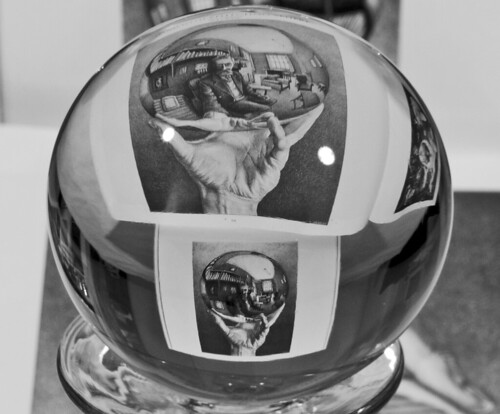
The biography, the life, the being, of a Quixote, a Hamlet, a Kane, is contained within the work, the artifact, the art. It is a sphere that we can stand outside of and look into, a crystal ball upon the teller's table. It is contained, limited (in the strictest sense: described), within the context of our being (although there is argument here - see Bloom). The biographer's task of representation is always beyond, at most, concurrent with his own being. Meditation upon a person reflected in a multitude of mirrors - biographical representations - can perhaps provide a more "holographic" portrait, but the innermost thoughts, the soliloquies of self meaning, remain occluded, shadows under the surface.


[ source ]


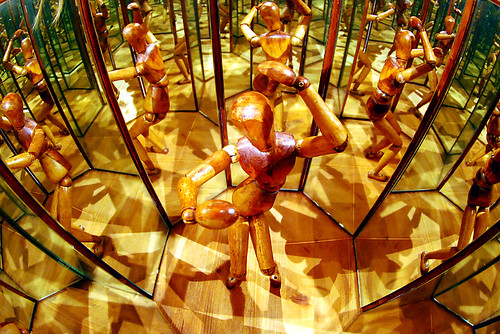
There is epistemological tension in this: who or what is represented in words about a man's life? Persona is indicated above - aspects of a mask. Questions fractal along the edge between language and reality. The Mirror of Representation cracks, slivers, melts on the threshold of the the Real, the Noumenon.


[ source ]


It is convenient (and, admittedly, suspect) to set up dialectical positions here: one implicitly affirming the validity of language as an instrument to reflect an accurate image of the World; the other rejecting the accuracy of the representation but still employing the language, oblivious - willfully so - to the implicit implications. Slice a dead horse as example: one holding the Mirror up to the World, believing the reflections to be real; the other attempting the shatter the Mirror to show that what is reflected is a false representation of... what? If not the World, perhaps the Subjective Real. The Mirror remains. Language is always transcendent over its representations.


In Mimesis, Erich Auerbach writes:

As recently as the nineteenth century, and even at the beginning of the twentieth, so much clearly formulable and recognized community of thought and feeling remained in those countries that a writer engaged in representing reality had reliable criteria at hand by which to organize it. At least, within the range of contemporary movements, he could discern certain specific trends; he could delimit opposing attitudes and ways of life with a certain degree of clarity. To be sure, this had long since begun to grow increasingly difficult. Flaubert (to confine ourselves to realistic writers) already suffered from the lack of valid foundations for his work; and the subsequent increasing predeliction for ruthlessly subjectivistic perspectives is another symptom. At the time of the first World War and after - in a Europe unsure of itself, overflowing with unsettled ideologies and ways of life, and pregnant with disaster - certain writers distinguished by instinct and insight find a method which dissolves reality into multiple and multivalent reflections of consciousness. That this method should have been developed at this time is not hard to understand.
But the method is not only a symptom of the confusion and helplessness, not only a mirror of the decline of our world. There is, to be sure, a good deal to be said for such a view. There is all these works  a certain atmosphere of universal doom: especially in Ulysses, with its mocking odi-et-amo hodgepodge of the European tradition, with its blatant and painful cynicism, and its uninterpenetrable symbolism - for even the most painstaking analysis can hardly emerge with anything more than an appreciation of the multiple enmeshment of motifs but with nothing of the purpose and meaning of the work itself. And most of the other novels which employ multiple reflection of consciousness also leave the reader with an impression of hopelessness. There is often something confusing, something hazy about them, something hostile to the reality that they represent. We not infrequently find a turning away from the practical will to live, or delight in portraying it under its most brutal forms. There is a hatred of culture and civilization, brought out by means of the subtlest stylistic devices which culture and civilization have developed, and often a radical and fanatical urge to destroy. [emph. mine]

Auerbach wrote Mimesis in exile from the Third Reich - without access to any of the primary texts. It was published in 1946. You can hear the thunder of the War in his language, the evening light of the "European tradition" pulses within the words. Yet, over half a century later, Joyce's love-hate montage resides within the same canonical zoo as Swift, Milton, Dante and Shakespeare. And whatever the aberrations of Modernism might have been, "the radical and fanatical urges to destroy" there were nothing compared to the Rough Beast that has now slouched into view.


[ source ]


An excerpt from an interview with Slavoj Žižek not long after the events of September 11, 2001:

Has 11 September thrown new light on your diagnosis of what is happening to the world?
Slavoj Žižek: One of the endlessly repeated phrases we heard in recent weeks is that nothing will be the same after 11 September. I wonder if there really is such a substantial change. Certainly, there is change at the level of perception or publicity, but I don't think we can yet speak of some fundamental break. Existing attitudes and fears were confirmed, and what the media were telling us about terrorism has now really happened.
In my work, I place strong emphasis on what is usually referred to as the virtualisation or digitalisation of our environment. We know that 60 percent of the people on this Earth have not even made a phone call in their life. But still, 30 percent of us live in a digitalised universe that is artificially constructed, manipulated and no longer some natural or traditional one. At all levels of our life we seem to live more and more with the thing deprived of its substance. You get beer without alcohol, meat without fat, coffee without caffeine...and even virtual sex without sex.
Virtual reality to me is the climax of this process: you now get reality without reality...or a totally regulated reality. But there is another side to this. Throughout the entire twentieth century, I see a counter-tendency, for which my good philosopher friend Alain Badiou invented a nice name: 'La passion du réel', the passion of the real. That is to say, precisely because the universe in which we live is somehow a universe of dead conventions and artificiality, the only authentic real experience must be some extremely violent, shattering experience. And this we experience as a sense that now we are back in real life.
Do you think that is what we are seeing now?
Slavoj Žižek: I think this may be what defined the twentieth century, which really began with the First World War. We all remember the war reports by Ernst Jünger, in which he praises this eye-to-eye combat experience as the authentic one. Or at the level of sex, the archetypal film of the twentieth century would be Nagisa Oshima's Ai No Corrida (In The Realm Of The Senses), where the idea again is that you become truly radical, and go to the end in a sexual encounter, when you practically torture each other to death. There must be extreme violence for that encounter to be authentic. [emph. mine]

Another emblematic figure in this sense to me is the so-called 'cutter'- a widespread pathological phenomenon in the USA. There are two million of them, mostly women, but also men, who cut themselves with razors. Why? It has nothing to do with masochism or suicide. It's simply that they don't feel real as persons and the idea is: it's only through this pain and when you feel warm blood that you feel reconnected again. So I think that this tension is the background against which one should appreciate the effect of the act.


It has been my project for many years to believe in the language as living thing, as having authentic being. In this manner, I often imagine the requirements for a biography of Language, not as a chronology of facts or historical events, but as a means of penetrating to into the core of Being, of unfolding the mystery. I have, in fact, been obsessed with this of late. This concern has been at the core of me and through all the violence and brutality that I have brought upon it with my attempts at creation and explanation, it has retained its gem-like flame.

From the Letter on Humanism by Heidegger:

Language is the house of Being. In its home man dwells. Those who think and those who create with words are the guardians of this home.


With thanks to Castrovalva's sublime Notes From Underground for links and inspiration.


Monday, September 17, 2007

Orson Whales: Moby Dick + Orson Welles + Led Zeppelin


Orson Whales from Alex Itin on Vimeo.

This is more or less a birthday gift to myself. I’ve been drawing it on every page of Moby Dick (using two books to get both sides of each page) for months. The soundtrack is built from searching “moby dick” on You Tube (I was looking for Orson’s Preacher from the the John Huston film), I couldn’t find the preacher, but you find tons of Led Zep and drummers doing Bonzo and a little Orson reading from the Novel for a failed Italian T.V. film…… makes for a nice Melville in the end.

Thursday, August 23, 2007

Dust is the signature of lost time.

"Rosebud."
Still from Citizen Kane - Orson Welles, 1941

The City
Lori Nix - Musem of Art, 2005


Via the enigmatic Museum of Dust:

Dust is what connects the dreams of yesteryear with the touch of nowadays. It is the aftermath of the collapse of illusions, a powdery cloud that rises abruptly and then begins falling on things, gently covering their bright, polished surfaces. Dust is like a soft carpet of snow that gradually coats the city, quieting its noise until we feel like we are inside a snow globe, the urban exterior transmuted into a magical interior where all time is suspended and space contained. Dust makes the outside inside by calling attention to the surface of things, a surface formerly deemed untouchable or simply ignored as a conduit to what was considered real: that essence which supposedly lies inside people and things, waiting to be discovered. Dust turns things inside out by exposing their bodies as more than mere shells or carriers, for only after dust settles on an object do we begin to long for its lost splendor, realizing how much of this forgotten object's beauty lay in the more external, concrete aspect of its existence, rather than in its hidden, attributed meaning.


Architecture of Dust
Incognita Nom de Plume


Dust brings a little of the world into the enclosed quarters of objects. Belonging to the outside, the exterior, the street, dust constantly creeps into the sacred arena of private spaces as a reminder that there are no impermeable boundaries between life and death. It is a transparent veil that seduces with the promise of what lies behind it, which is never as good as the titillating offer. Dust makes palpable the elusive passing of time, the infinite pulverized particles that constitute its volatile matter catching their prey in a surprise embrace whose clingy hands, like an invisible net, leave no other mark than a delicate sheen of faint glitter. As it sticks to our fingertips, dust propels a vague state of retrospection, carrying us on its supple wings. A messenger of death, dust is the signature of lost time.


Walter Martin & Paloma Muñoz
Traveler 173 at Night, Snowglobe - 9x6x6


Kraken - AMNH
©2007 - Denis Finnin -


From Celeste's World:

The Artificial Kingdom: A Treasury Of The Kitsch Experience - Rather than engaging the tired stances that see kitsch as either bad taste or a bad copy of «true art», this book presents it as a cultural sensibility of loss, tracing its origins as a massive phenomenon to the nineteenth century. Presenting kitsch as the ambivalent «cristallization» of the lost experience of pre-industrial life, TAK explores this sensibility through the objects and narratives that it produced, in particular those related to the popular underwater imagery of the time: aquariums, paperweights, the myth of Atlantis and Jules Verne’s 20,000 Leagues Under the Sea.

Feejee mermaid - AMNH
The original "Feejee mermaid," made famous by P. T. Barnum, is believed to have been destroyed in a fire-but some people think this one may be it. More than 100 years old, it was rediscovered in 1973. Some scholars connect it to Barnum but its exact origins are unknown.© 2007 Harvard University, Peabody Museum


From Wikipedia: Kitsch:

The more romantic a work of art, or a landscape, the quicker its repetitions are perceived as kitsch or ‘slush.’

- Arthur Koestler

Kitsch is the absolute denial of shit, in both the literal and figurative senses of the word; kitsch excludes everything from its purview which is essentially unacceptable in human existence.


Kitsch is the expression of passion at all levels, and not the servant of truth. It keeps relative to religion and truth...Truth, kitsch leaves for (modern) art. In kitsch skill is the important criteria...Kitsch serves life and seeks the individual.

- Odd Nerdrum, Kitsch - The Difficult Choice


Memory Theatre
Pablo Helguera, 2004


From Vorträge:

What differentiates Camillo from today's cybernauts and sheds light on the possibly untapped potential of the digital theater of memory is the fact that his data construction always appears as theater. The sites and images of his model are not meant to fascinate in an unmediated way, but should rather be reflected on as staged objects. They are imagines agentes, active, actuating images, not because their specific function is the "painting of an entire scene," but rather because the imagination is stimulated through their agency. Camillo expressly emphasizes the matter that concerns him: "to find, in these seven comprehensive and diverse units, an order that keeps the mind keen and shakes up the memory." In contrast, the technical activation of images by means of computer animation does not lead to reflection but is instead perceived passively, in a reflex-like manner; instead of shaking up the memory, it conditions it. Camillo's theater presents itself as an enclosed space, and, precisely for that reason, incites one to transcend it. On the other hand, the forms of 3D visualization, which give the illusion of endless space, prevent the data-traveler from realizing that the trajectory of his transit is fixed and thus undermine the desire for transcendence.

A Sanctuary for Memories of Play
James Skvarch - 1999

This fundamental difference in reception despite a superficial similarity of presentation was brought about as a consequence of an earlier technological transformation, which makes itself manifest on hand of the change in panorama technology at the beginning of the 19th century. As Jonathan Crary emphasizes, a decisive turnabout in the techniques of observation takes place at this time: In the older panoramas (such as the famous London one of 1791), the visitor walked about inside; in the diorama of 1823, the observer stood at a fixed point, and the panoramic image revolved around him. Thus, the activity of the recipient was literally brought to a standstill – that is to say, transferred over to the apparatus. An analogous phenomenon can, in my assessment, be traced in the difference between the memory theaters of the Renaissance and the animated virtual reality scenarios of today's computer interfaces. In Camillo's theater, the visitor similarly went inside and actively moved within the collection of memories, while the computer navigator, armed with his mouse, is condemned to immobility before the screen. In contrast to Crary, however, I see this difference as being purely metaphorical. It is not necessary to set the body in motion in order to mobilize the mind (that the Peripatetics philosophized ambulando is commonly known to be a rumor). It is not necessary to do away with sitting still in front of the screen in order to achieve mental mobility in Camillo's sense – and besides, the bodily movements of the user come into play again in the newer "cave" installations. What is decisive is the orientation of inner movement. With computer animation, it is directed unambiguously at the consumption of an object; in Camillo however, the self-reflexive contemplation of the object by a subject also involves a rebound movement back to the subject. This reflexivity is made evident in Camillo's inversion of the theater structure, which places the objects of memory in the tiers, where they simultaneously return the gaze of the observer while he stands on the stage and constitutes the center of intellectual activity. This inversion of the classical Vitruvian theater means that Camillo had already effected a reversal of the very transformation that Crary pinpoints as only having first taken place with the diorama. Thus, Camillo stands at a critical distance not only to the traditional memory architectures of the ancients, but also to the systems of memory theater developed immediately after his – from Zwinger's Theatrum vitae humanae (1565) and Quicchebergs Inscriptiones vel tituli theatri amplissimi (1565) through Pierre Boaistuau's Theatrum Mundi (1581), Lomazzo's L'Idea del Tempio della Pittura (1590),Bodin's Universae Naturae Theatrum (1597) and Alsted's Theatrum Scholasticum (1610), to the Theatrum orbi in Robert Fludd's Ars memoriae (1697).


This fetish approach to his collecting and arranging is very clear in the development of Penny Arcade Portrait of Lauren Bacall. Hauptman writes that Cornell disliked the ‘sexual hoopla’ around Bacall but was taken by the photograph of Bacall in publicity for To Have and Have Not. He decided to do a box, collecting and continuing to rearrange that box via associations until his death. ‘Cornell called these “paths ever opening up,” “extensions,” chains of associations made visual in the work’s box structure.’

Tuesday, April 17, 2007

Orson Welles :: Moby-Dick


Call me Ishmael
:


""That same image selves see in all rivers, in oceans, in lakes and in wells, the images of the ungraspable, the phantom of life... and that is the key to it all."


The Afterdeck - A Fair Morning
:


"His splintered helmet of a brow... old Ahab drops a tear into the sea... how does the vast Pacific hold such wealth as that one drop?"


Cut No Good
!


"Bad omen... Omen... Omen... If the gods would speak to men they'll speak outright... not shake their heads and give an old wife's darkling hint. Hands off! Ye two are of mankind! Old Ahab stands alone among the millions of the peopled earth nor gods nor men his neighbors! Cut no good!


From the New York Times: That Great White Whale Through a Wellesian Lens By Jason Zinoman - March 10, 2007

It takes a fool or perhaps a genius to adapt one of the greatest American novels for the stage -- and Orson Welles was a bit of both. He chased ''Moby-Dick'' through much of the 1950s. After writing and starring in ''Moby Dick -- Rehearsed'' in 1955, he made his own film version of that Melville classic for British television before starring in John Huston's. But Welles still wasn't finished, returning to the novel at the end of his life, filming scenes of himself reading it in one of his many unfinished works. (There are remarkable excerpts on YouTube.)

Welles may never have caught the big fish in the same way that he captured, say, William Randolph Hearst in ''Citizen Kane,'' but this gripping revival of ''Moby Dick -- Rehearsed,'' presented by Twenty Feet Productions with a Shakespearean sweep, proves that this was a perfect marriage of man and material.

It's easy to forget that Welles was first a man of the theater, and this ferocious drama, a poetic examination of one man's obsession, is, among other things, a celebration of the stage. It begins almost offhandedly with a group of actors filing into the theater where they are to perform ''King Lear.''

In a light, almost documentary style, Welles satirizes backstage small talk: the complaints about critics, pay and academics. When one performer talks about the need for theater, another corrects him: ''Nobody ever needed the theater -- except us. Have you ever heard of an unemployed audience?''

When the vain star (Seth Duerr) enters, he informs the ensemble that they will be performing ''Moby-Dick'' instead of ''Lear,'' and that he will play Ahab. This framing device provides a justification for the bare-bones adaptation (everyone wears casual clothes and mimes the props), but the director, Marc Silberschatz, is smart to avoid hammering home the theatrical themes, since the play-within-a-play conceit has become a cliché.

Instead, he concentrates on suspending our disbelief, relying on a direct, simple staging that tells the story with gusto and clarity. The cramped theater, a black box with bad sightlines, actually helps give a sense of being trapped on a rickety ship.

Welles, who ruthlessly edited Melville's novel down to two hours, would no doubt have approved of Dana Sterling's moody lighting design. But this play rises and falls on the strength of Ahab, and Mr. Duerr is happily up to the challenge. With sunken eyes that betray a touch of madness, he looks like a man losing a battle but refusing to give up.

He doesn't perform off his fellow actors so much as recite his lines to the heavens, which makes perfect sense, since he's playing a dictatorial actor playing a dictatorial captain. At his best, Mr. Duerr's booming baritone even brings to mind Welles himself. Call me impressed.


Thanks to http://ismaels.wordpress.com

Saturday, July 09, 2005

Orson Welles: Filming Othello

The Tragedy of Othello: The Moor of Venice (1952)
Directed by Orson Welles


More items Wellesian: found on the excellent site wellesnet.com. For some reason, maybe only endemic to my idiosyncratic perspective, Welles' Othello seems to be one of his more "overlooked" films - if such a word even applies to the minutely researched films of Orson Welles. I remember how stunned I was upon first viewing. I had already seen Kane, Ambersons, and Touch of Evil many times. Othello, while still having all the hallmarks of a Welles creation, seemed entirely new to me. Not quite an evolution, but close. I set it right next to Chimes at Midnight in the sense that it shows the sort of remarkable range he had - especially to complete such films under such adverse conditions.

The transcript below is well worth reading in it's entirety - and worth posting for the Carlyle quote alone.

A Complete transcription of Welles' last finished film: Filming Othello and an interview with cinematographer Gary Graver by Lawrence French. All material courtesy of Lawrence French.

A long clip of the opening funeral scene from OTHELLO (1952) is shown, and then we see Orson Welles sitting at a movieola, having just run that scene.

ORSON WELLES: This is a movieola. A machine for editing film, but you know, when we say we're editing or cutting a film, we're not saying enough. Movies aren't just made on the set. A lot of the actual making happens right here; a movieola, like this is very nearly as important as the camera. Here films are salvaged, saved sometimes from disaster, or savaged out of existence. This is the last stop on the long road between the dream in a filmmaker's head and the public when that dream is addressed. (Thomas) Carlyle said that almost everything examined deeply enough will turn out to be musical. Of course this is profoundly true of motion pictures. The pictures have movement; the movies move. Then there's the movement from one picture to another. There's a rhythmic structuring to that; there's counterpoint, harmony and dissonance. A film is never right, until it's right musically. This movieola, this filmmaker's tool, is a kind of a musical instrument. It's here that other film instruments are tuned or finely orchestrated, so as we're finally ending up our conversation here, you'll understand that as a filmmaker I'm speaking to you from my home.

This is to be a conversation, certainly not anything so formal as a lecture, and what we're going to talk about is OTHELLO. Shakespeare's play and the film I made of it. That sounds rather arrogant doesn't it, just naming the two in the same sentence. The truth is, of course that by any real standard of worth, comparison is not merely impossible, it's absurd. The play is something more than a masterpiece. It stands through the centuries as a great monument to western civilization. Take an arbitrary figure: Twelve. Name twelve plays which could be called great. OTHELLO must be one of those twelve. Of that twelve, at least nine (which is another arbitrary figure) are by Shakespeare. That leaves three on our list for all the other writers who ever lived. Is that putting it too strongly? Or is it too high? You can't go higher than that, and Shakespeare remains immortally number one. Among all dramatists the first. The greatest poet, in terms of sheer accomplishment, very possibly our greatest man. So where does that leave a mere moviemaker? Nowhere. Nowhere at all, unless we leave out all comparisons and consider that my OTHELLO, based upon, adapted from and inspired by William Shakespeare's tragedy has some little right to be considered on whatever merit it may presume to have as a movie. And yet, if merits there be, this is not at all a conversation, nor am I the conversationalist to treat it. Don't imagine for a moment that I'm pretending to be modest, it's just my fixed conviction that critical opinions about one's own work should be left to others. Is my movie, OTHELLO good or bad, flawless or flawed, a masterpiece or a mess? It's been vigorously and viciously attacked, denigrated and dismissed and also praised, sometimes quite extravagantly. I don't know your opinion. I won't tell you mine. I can't help the movie by telling you it's good, or if I think it's bad, if I really do, I better not say so. Why? Because this movie is still being shown in theaters. (laughter) People are still going to see it, and I'll admit to feeling quite happy about that. Good or bad there's still some kind of life in it, which is the reason I'd be sorry and I guess pretty foolish to do anything to kill it

Tuesday, June 14, 2005

Orson Welles and the Mercury Theatre on the Air

orson welles eye and I


I am a devoted fan of all things Wellesian. For some time, I have hungered for online audio files of the old Mercury Theatre on the Air radio recordings. A while back, I discovered the wonderful site, The Mercury Theatre on the Air, but was frustrated with the slow download times (to save on bandwidth, the Webmaster explained). However, on a recent return, I was delighted to discover that he now has all of the mp3s for download as a torrent file.

This includes: 45 Campbell's Playhouse productions, all 7 audio-chapters of Les Miserables, 7 Mercury Theatre on the Air productions as mp3s and 10 as RAM files, a short piece on Welles Meets Wells, "a radio special about the Mercury Theatre on the Air hosted by Leonard Maltin, featuring interviews with the surviving members" (which is amazing), a rehearsal of The 39 Steps and a priceless mpeg4 video of the famous all-black Macbeth.

There is also a wealth of excellent information on the Mercury Theatre on the site, including a history and complete show lists.

It is like Christmas.

Other sources:
Laughing Bone Archives: Father Mapple's Sermon
Wikipedia: Orson Welles
Critique Magazine: Orson Welles, the New Deal, and the Mercury Theatre on the Air

Addendum: From the FAQ regarding copyright:

Who owns the copyright on these shows?

Copyright on old radio shows is an extremely hazy area. Nobody seems to know who owns the rights to these broadcasts, and a good argument could be made that they’re public domain. A couple obnoxious individuals over the years have claimed that they own the rights to certain shows and have threatened to sue collectors and webmasters that have made episodes of the shows available. Tellingly, they’ve never actually taken anyone to court, and have only relied on bluster to assert their ownership.

For further exploration of these issues, please see the OTR Law Journal.

Friday, March 18, 2005

Father Mapple's Sermon From Moby-Dick

orson welles as father mapple
As Rendered By Orson Welles in John Huston's Filmed Version of Herman Melville's Novel, The Whale. Or As It Is Commonly Known, Moby-Dick:

AND GOD PREPARED A GREAT FISH TO SWALLOW UP JONAH...

Shipmates, the sin of Jonah was in his disobedience of the command of God. He found it a hard command. And it was, Shipmates. For all of the things that God would have us do are hard. If we would obey God, we must disobey ourselves. But Jonah still further flaunts at God by seeking to flee from Him. Jonah thinks that a ship, made by man, will carry him into countries where God does not reign.

He prowls among the shipping like a vile burglar hastening to cross the seas. And as he comes aboard, the sailor's mark him. The ship puts out. But soon the sea rebels. It will not bear the wicked burden. A dreadful storm comes up. The ship is like to break. The bosun calls all hands to lighten her: boxes, bails, and jars are clattering overboard. The wind is shrieking. The men are yelling.

- I fear the Lord! cries Jonah. The God of Heaven who hath made the sea and the dry land!

Again, the sailors mark him: Wretched Jonah cries out to Him! Cast him overboard. For he knew.

For his sake, this great tempest was upon them.

Now behold Jonah: taken up as an anchor and dropped into the sea, into the dreadful jaws awaiting him.

And the Great Whale shuts to all his ivory teeth like so many white bolts upon his prison. And Jonah cries unto the Lord, out of the fish's belly. But observe his prayer, Shipmates. He doesn't weep or wail. He feels his punishment is just. He leaves deliverance to God. And even out of the belly of Hell, grounded upon the ocean's utmost bones, God heard him when he cried.

And God spake unto the Whale. And from the shuddering cold and blackness of the deep, the Whale breeched into the sun and vomited out Jonah on the dry land. And Jonah, bruised and beaten, his ears like two seashells, still mutlitudinously murmuring of the ocean, Jonah did the Almighty's bidding.

And what was that, Shipmates? TO PREACH THE TRUTH IN THE FACE OF FALSEHOOD.

Now Shipmates, woe to him who seeks to pour oil on the troubled waters when God has brewed them into a gale. Yea, woe to him who, as the Pilot Paul has it, while preaching to others is himself a castaway. But delight is to him who against the proud gods and commodores of this earth stands forth his own inexorable self, who destroys all sin, though he pluck it out from the robes of senators and judges! And Eternal Delight shall be his, who coming to lay him down can say:

- Oh Father, mortal or immortal, here I die.
I have driven to be thine,
more than to be this world's or mine own,
yet this is nothing
I leave eternity to Thee.

For what is man that he should live out the lifetime of his God?

job and the whale


In Rosebud: The Story of Orson Welles, David Thompson writes:

Welles did his own text, and then, when gently pressed, he did Huston's. It is magnificent, thunderous and as incantatory as Melville's prose. No actor could kill or waste the speech - but only someone of Welles's grandeur could do it justice. Here is proof that on the grand scale of voice, physique and imaginative reach he was a noble actor - a stage actor, someone to fill a large hall. Yet there is more. As Mapple pursues the Jonah story to its end, and Jonah speaks to God, Huston used the close-up to cover Welles's heartrending "For what is man that he should outlive the lifetime of his God? Suddenly, we see an old man, or one alert to mortality. The last line is nearly a whisper; it was the most delicate thing Welles had done in forty years. Always uneasy with youth, he had some intimation of the grave, solitary splendor of old age. It is there in his Mapple. The crew gave him an ovation when he had finished. Huston chuckled at his own acute enterprise, and Welles bellowed with relief. If he had never done anything else, you would say, "Good God, what was that?"

Sunday, February 27, 2005

Dual Moments: 3D Computing

Nothing has made me smile as much recently as sitting in front of my computer with a pair of old-style red and blue 3D glasses looking at images from the Dual Moments website:


Almost like you could reach out and shoot him.


The frames from Citizen Kane are beauties.
Makes you wonder why such masters of field depth
as Greg Toland and Welles never did anything 3D.

There are more historical images and scenes from films on the site. In addition, there is a link to a guy willing to send you 3D glasses for free - no strings. (Found via MackWhite.com)