Showing posts with label memory. Show all posts

Tuesday, April 10, 2018

A Conversation with Shelton Walsmith: "Somehow the question keeps the torch lit."


Shelton Walsmith


SC: Again, I'm always in for the more restrained color palette. The Mytho-poetic imagery. I've been reading Book 6 of the Aeneid, the journey of Aeneas into the underworld in search of his father. Just before he died, Seamus Heaney made a translation. Upon finally finding the shade of his father, Aeneas attempts to embrace him:

"Let me take your hand, my father, 

O let me, and do not
Hold back from my embrace.

And as he spoke he wept. 

Three times he tried to reach arms round that neck.

Three times the form, reached for in vain, escaped

Like a breeze between his hands, a dream on wings."


Shelton Walsmith

Shelton Walsmith


SW: I like the pitch of the emotion in that writing. I recently saw Teagle in the play Is God Is? Most of the performance is in a claustrophobic shallow set with a windowed wall close to the front of the stage. Towards the end, Teagle pushes the wall backward and it falls with a crash at a 45 degree angle. He then climbs it to have a showdown with a daughter who's come to kill him. The 4th wall of theater transgressed.

SC: I've been listening to Lee Morgan's Cornbread. It's pure Sunday morning to me.

SW: He managed to infuse those recordings with with joie de vivre.

SC: Overflowing exuberance.

SW: I can turn my frown upside down by simply playing Sidewinder record. Same thing with Django Reinhardt.


Shelton Walsmith


SW: Couldn't find any Lee Morgan at the studio but looking I rediscovered a great by Lee Konitz titled Another Shade of Blue.

SC: I'll check it out. I've always admired how prolific jazz musicians are. Hundreds of albums. The live improvisation and "real presence" of the music being antithetical to closeted perfectionism and hermetic solipsism. 


Shelton Walsmith


SW: Here here. A lot of stuff in the heyday pre-1963 is praying - a very clear transcription of presence. Did you read Giacometti discussing the pursuit of presence? He was all about exposing the ghost and making it playback - recording the playing as it lives -  as you mention. The records of Segovia, Glenn Gould or Kronos Quartet are performance/recorded like jazz live. 

It's been a blessing to take on this bather exhibition. Like you saying, I'm Back! to yourself at the Bellingham library. While I'm drawing studiously daily, I feel most at home. Going through tons of moleskins looking for precedent is a also reminder how much energy and looking and recording I've devoted to drawing. It's an instrument of human thought sounding or touching. It's a lot of rehearsing for painting but it also remains strong as an end to the means.

SC: Not to remark upon a trivial example, but perhaps appropriate for its lack of pretension, I am increasingly aware of how unconsciously practiced and accomplished am I for this work. As if some Mr Miyagi from the Karate Kid has had me painting the fence or waxing the car for years, honing skills I was unaware I possessed. Over 20 years meditation upon a theme, writing poems, songs, prose, creating graphics until is all second nature, like riding a bike. I no longer think about writing: it is an unconscious vehicle to transport me to my destination. I'm pretty happy when I realize this anew. Look ma! No hands!

SW: Exactly.


Shelton Walsmith

Shelton Walsmith

Shelton Walsmith


SC: The immediate provisionality of the sketchbook, the "showing of the work", is always fascinating. Seeing how the sausage is made. Or perfume.


Shelton Walsmith


SC: Sweet.


Shelton Walsmith

Shelton Walsmith

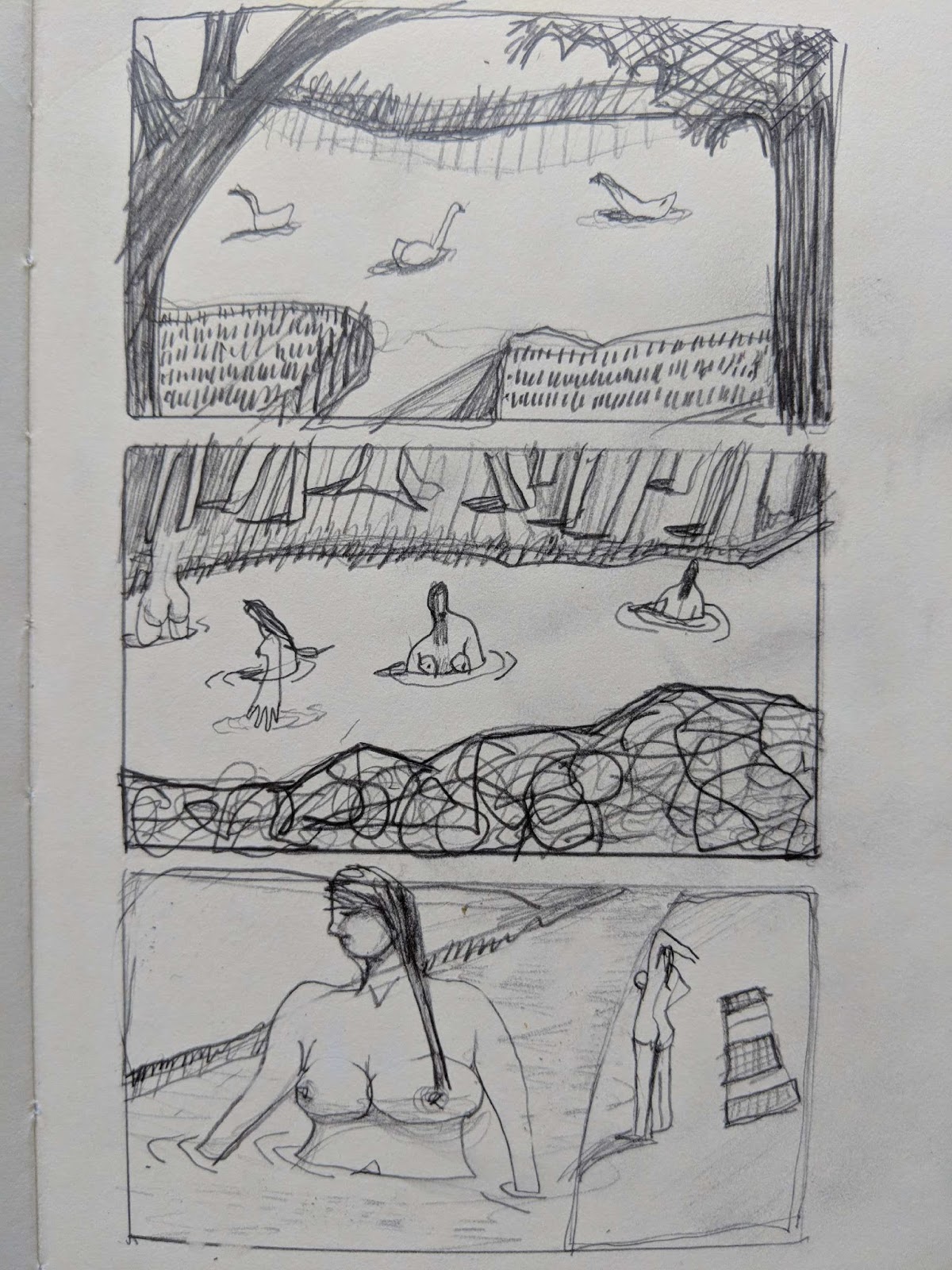
SC: Something in the natural, but muted eroticism of the bathers. Not nude, but just there. The idea of the Venus de Milo in a bikini. It's interesting.

SW: There's something to how open the kimono is...revealing the right amount hiding the best parts. I want to tap into an endless summer atmosphere wherein ghosts are represented as passersby in rivers and lakes and surf. You're always younger when you're swimming and younger is always past. It's a proverbial fish bowl looked on by Prospero. 

SC: Nicely put. Re: Eliot:

Now the hedgerow
Is blanched for an hour with transitory blossom 
Of snow, a bloom more sudden 
Than that of summer, neither budding nor fading, 
Not in the scheme of generation.
Where is the summer, the unimaginable Zero summer?


Shelton Walsmith

Shelton Walsmith


SW: I've continued to study Mark Tansey for his monochromatic mastery and disjointed narrative send offs on sentiment, nostalgia, redacted history and painting about painting. See his "Action paintings"1 and 2. Making grayscale or monochromatic fiction emerges, it's not true to life in it's reduction to tonal over coloristic. My inquiry into how to make it more artificial than lifelike launches a type of Once upon a time...

By grouping them as diptychs or triptychs the additional frame or filmic cell reels another engine of narrative movement


Shelton Walsmith

Shelton Walsmith

SC: Those are excellent. The Muybridge filmic nostalgia.

SW: Like the Disney analogue animation m.o. endless drawings, same but different, not just feeling innocence but also and reanimated call and response btw having it and losing it. Reality vs. recollection. Someone remembered so often their face gets warn off until the memory is grasping as featureless ghosts receding.


Shelton Walsmith


SW: The sexual highlight reel too often revisited goes from lucid real time play by play recollection to blippy gif like compression. Instead of the short film you had now the memory 3 or 4 vignettes flipbooking then it's one long exposure compressed into a single image then  that photograph becomes worn and loses detail to wear and attrition...


Shelton Walsmith

Shelton Walsmith

SC: You are exactly right. Film offers an all too easy metaphor for memory that, while evocative, is not accurate. I think people born in the age of film and now smart phones will think of memory as a message aligned with those mediums: a slow motion panning shot of a walk to the altar, soundtracked with a favorite song, close up on the face, or, far worse, their lives as a series of posed/ not posed filter / no filter selfies. The creative and interpretively demanding windows opened by a work of art with its constantly shifting meanings and aporia are traded for these more compressed representations of the experience - the plastic souvenir remembered instead of the experience itself. The capacities of memory are vast and energized by immersion to the most profound depths. Borges said one of the most signal moments in the development of Western culture was when Aeschylus introduced a second actor onto the stage. No longer a single singer or priest addressing the crowd directly, but a re-presentation of reality, as two actors magically create a dramatic universe we view as non-participatory spectators. No wonder the earliest memory systems were memory theaters. Internal private stages where we each enact our own myths. Something Freud "discovered" as a unexplored country within. 

SW: Isn't interesting that in the first chapter of photography that a negative image needed to be born before it's positive inverse could document the latent image?

A lot of those glass plates that documented Civil War death were destroyed or repurposed as greenhouse windows. It was best forgotten and the photos were a terrible reminder. That reminds me of the Van Gogh scholar researching his haunts and homes discovering a former landlord was using one his paintings traded for rent as the door to her henhouse. The real fate of most pictures rather than d'Orsay, Sotheby's or Hong Kong penthouses.

SC: There is something philosophically and aesthetically beautiful about those images. The eternal question: what is art good for? What does it do? For some, it's a good window, something with which to build a door. Keiffer's monumental leaden books come to mind. But so do the pyramids. And Guernica. 

SW: The use of art or the use of the art encounter is best from the cheap seats in a theatre watching a play. No one's fooling anybody from there and the necessary suspension of disbelief is transferrable into poetry, music and the plastic arts if one needs to ask the question, to what end? Or what use is it?  Suspension of functional practicality. Why take soot or blood and make a handprint or drawing of a bison on the cave wall? To what end? Somehow the question keeps the torch lit. Imaging or reimagining or projecting of mere shadows of the real thing ignites inquiries into the substance of sight and the weight of remembering. Mona Lisa looks at us looking at her and a cycle of wonder loops.

SC: Beautiful. Could my epitaph: 

"To what end? Somehow the question keeps the torch lit. Imaging or reimagining or projecting of mere shadows of the real thing ignites inquiries into the substance of sight and the weight of remembering."

SW: Often progress in art is retrospective like turning your back to the mirror and panning your sightlines back over your shoulder at the view you walking away. Michaelangelo is looking at the ancients and literally thinking, to beat these are guys 

...to beat these guys I need to see  grandeur and monumentality as they saw/projected it. 

Kiefer progressed art by seeing/deposing Nazi hegemony in favor of a pre third Reich Mother Germany. All thru backward visioning. The PreRaphaelite painters pushed into magic realism by genre hopping backward.

SC: Consonant with Borges idea that a writer's awareness of his precursors not only informs his present work, but alters our conception of the past. History is a lie of the mind and as fluid as any story. Thus, he says we now know Homer's Odyssey as coming AFTER Joyce's Ulysses. He cites Whistler's answer to the question of how long it took him to paint one of his nocturnes. Whistler answered, all of my life. "With the same rigor he could have said all the centuries that preceded that moment when he painted were necessary."


Shelton Walsmith


SW: When you answer To what end?  With a political message in visuart at least those aforementioned suspensions become flattened and rigid and to an known end. Political art smells like a doctor's office.

SC: The etymological sense of porno graphia - writing about prostitutes, those who allow themselves to be bought and used for other's purposes. Most of our current culture is pornography to me, more insidious because it tries so desperately to pretend as if it is not. 


Shelton Walsmith


SW: Yeah, we're a mess.

SC: 
Well, I went to the doctor
I said, "I'm feeling kind of rough"
He said, "I'll break it to you, son"
"Let me break it to you, son"
Your shit's fucked up."
I said, "my shit's fucked up?"
Well, I don't see how-"
He said, "The shit that used to work-
It won't work now." - Warren Zevon


Tuesday, May 09, 2017

Give not that which is holy unto the dogs


From the Paris Review: Writ in Water


Jesus, Socrates and the Buddha, never wrote any word that has been preserved.

1 Jesus went unto the Mount of Olives.
2 And early in the morning he came again into the temple, and all the people came unto him; and he sat down, and taught them.
3 And the scribes and Pharisees brought unto him a woman taken in adultery; and when they had set her in the midst,
4 They say unto him, Master, this woman was taken in adultery, in the very act.
5 Now Moses in the law commanded us, that such should be stoned: but what sayest thou?
6 This they said, tempting him, that they might have to accuse him. But Jesus stooped down, and with his finger wrote on the ground, as though he heard them not.
7 So when they continued asking him, he lifted up himself, and said unto them, He that is without sin among you, let him first cast a stone at her.
8 And again he stooped down, and wrote on the ground.
9 And they which heard it, being convicted by their own conscience, went out one by one, beginning at the eldest, even unto the last: and Jesus was left alone, and the woman standing in the midst.

Some claim he wrote the names of all those who were with sin, shaming them. Others that he inscribed into the earth the names of all those who didn't believe. Or that he wrote a single word: Unforgiven. But there is no indication any man ever read the only words ever written down in the dust by Jesus. It's amusing to consider he, like the wily Ulysses, wrote: "No Man," for it illuminates the following exchange with the adulteress:

10 When Jesus had lifted up himself, and saw none but the woman, he said unto her, Woman, where are those thine accusers? hath no man condemned thee?
11 She said, No man, Lord. And Jesus said unto her, Neither do I condemn thee: go, and sin no more.

All of this just antecedent to the book chapter verse of John 3:16 written upon sheets hung over stadium walls where we go to witness violence. Most recently, upon the forehead of a suicide. Unforgiven. No Man.

In the essay, On the Cult of Books, Borges writes:

It is well known that Pythagoras did not write; Gomperz (Griechische Denker I, 3) maintains that it was because he had more faith in the virtues of spoken instruction. More forceful than Pythagoras' mere abstention is Plato's unequivocal testimony. In the Timaeus he stated: "It is an arduous task to discover the maker and father of this universe, and, having discovered him, it is impossible to tell it to all men"; and in the Phaedrus he recounted an Egyptian fable against writing (the practice of which causes people to neglect the exercise of memory and to depend on symbols ), and said that books are like the painted figures "that seem to be alive, but do not answer a word to the questions they are asked." To alleviate or eliminate that difficulty, he created the philosophical dialogue. A teacher selects a pupil, but a book does not select its readers, who may be wicked or stupid; this Platonic mistrust persists in the words of Clement of Alexandria, a man of pagan culture: "The most prudent course is not to write but to learn and teach by word of mouth, because what is written remains" (Stromateis), and in the same treatise: "To write all things in a book is to put a sword in the hands of a child," which derives from the Gospels: "Give not that which is holy unto the dogs, neither cast ye your pearls before swine, lest they trample them under their feet, and turn again and rend you." That sentence is from Jesus, the greatest of the oral teachers, who only once wrote a few words on the ground, and no man read what He had written (John 8:6).

 Following, Plato tellingly writes the words of Socrates in the Phaedrus:

Soc. At the Egyptian city of Naucratis, there was a famous old god, whose name was Theuth; the bird which is called the Ibis is sacred to him, and he was the inventor of many arts, such as arithmetic and calculation and geometry and astronomy and draughts and dice, but his great discovery was the use of letters. Now in those days the god Thamus was the king of the whole country of Egypt; and he dwelt in that great city of Upper Egypt which the Hellenes call Egyptian Thebes, and the god himself is called by them Ammon. To him came Theuth and showed his inventions, desiring that the other Egyptians might be allowed to have the benefit of them; he enumerated them, and Thamus enquired about their several uses, and praised some of them and censured others, as he approved or disapproved of them. It would take a long time to repeat all that Thamus said to Theuth in praise or blame of the various arts. But when they came to letters, This, said Theuth, will make the Egyptians wiser and give them better memories; it is a specific both for the memory and for the wit. Thamus replied: O most ingenious Theuth, the parent or inventor of an art is not always the best judge of the utility or inutility of his own inventions to the users of them. And in this instance, you who are the father of letters, from a paternal love of your own children have been led to attribute to them a quality which they cannot have; for this discovery of yours will create forgetfulness in the learners' souls, because they will not use their memories; they will trust to the external written characters and not remember of themselves. The specific which you have discovered is an aid not to memory, but to reminiscence, and you give your disciples not truth, but only the semblance of truth; they will be hearers of many things and will have learned nothing; they will appear to be omniscient and will generally know nothing; they will be tiresome company, having the show of wisdom without the reality. 

Language dissolving like a castle of sand in the advancing surf. The woven pattern raveling unraveling, reversive, intensive, ambiguous. The word cannot contain the thing :: as the thimble cannot contain the ocean. All acknowledge it stands for, signifies, but is not the thing itself. But a malevolent cogito emerges when spelled out into words: I think, I am but when I write, I am no longer. Every word is a Procrustean Bed wherein my flesh is carved away and limbs hacked off to fit into a dead child's Sunday School suit. I am not so described. The Cloud of Knowing that is my self is a Galaxial Milky Way whirlpool whirling.

"For this discovery of yours will create forgetfulness in the learners' souls, because they will not use their memories; they will trust to the external written characters and not remember of themselves. The specific which you have discovered is an aid not to memory, but to reminiscence, and you give your disciples not truth, but only the semblance of truth."

What testimony will endure of any one of us? What is the meaning of the word written into the dust? Or upon the water? Or upon the stone?


This grave contains all that was Mortal 
of a 
Young English Poet
Who 
on his Death Bed, 
in the Bitterness of his Heart 
at the Malicious Power of his Enemies 
Desired 
these Words to be engraven on his Tomb Stone: 

Here lies One 
Whose Name was writ in Water. 

24 February 1821.


James Henry Breasted copying a hieroglyphic text in the temple of Buhen, Egypt


He pressed the leaves of trees and plants into his book and he stalked tiptoe the mountain butterflies with his shirt out-held in both hands, speaking to them in a low whisper, no curious study himself. Toadvine sat watching him as he made his notations in the ledger, holding the book toward the fire for the light, and he asked him what was his purpose in all this…
Whatever exists, [the Judge] said. Whatever in creation exists without my knowledge exists without my consent.
He looked about at the dark forest in which they were bivouacked. He nodded toward the specimens he’d collected. These anonymous creatures, he said, may seem little or nothing in the world. Yet the smallest crumb can devour us. Any smallest thing beneath yon rock out of men’s knowing. Only nature can enslave man and only when the existence of each last entity is routed out and made to stand naked before him will he be properly suzerain of the earth…
The judge placed his hands on the ground. He looked at his inquisitor. This is my claim, he said. And yet everywhere upon it are pockets of autonomous life. Autonomous. In order for it to be mine nothing must be permitted to occur upon it save by my dispensation.
Toadvine sat with his boots crossed before the fire. No man can acquaint himself with everything on this earth, he said.
The judge tilted his great head. The man who believes that the secrets of the world are forever hidden lives in mystery and fear. Superstition will drag him down. The rain will erode the deeds of his life. But that man who sets himself the task of singling out the thread of order from the tapestry will by the decision alone have taken charge of the world and it is only by such taking charge that he will effect a way to dictate the terms of his own fate. 

- Blood Meridian, Cormac McCarthy 


Saturday, December 21, 2013

Piphilology: Mnemonics for Pi: O, lest the world should task you to recite


source


More of the Memory Project. Memorization of poems, prose, songs, lists are all enhanced by the meaningful context, syntax, semantics, cause and effect, mathematical sequence and chronology. Spiritual, mental, emotional and physical associations arise, in a manner or speaking, out of the thing being committed to memory. What it means to learn something "by heart."

Then there is the mathematical constant π: the ratio of a circle's circumference to its diameter:  3.14 as it is most commonly known. It is an irrational number, infinite with no repeats. As far as memory is concerned, it has an aura of purity around it. Pure memorization. No rhyme or reason to it. Nothing to lock on to. Just an endless series of numbers.

The current record holder is Mr. Chao Lu from China, who on November 20th, 2005 spent 24 hours and 4 minutes reciting Pi to 67,890 places. In an interview, he said that it took him a year to memorize that many digits. In 2006, Krishan Chahal from India recited Pi to 43,000 places in 5 hours and 21 minutes. It is worth noting that the youngest person on the Pi World Ranking List is 6 year-old Sarianna Kuuttila, who recited Pi to 20 digits in 4.47 seconds.

There are many methods for memorizing Pi. Piphilology is the study of mnemonic techniques for Pi. Since I use poetry and music as primary mnemonic aids, I was interested to find two mnemonic poems to Pi. The first, composed by Jill Britton, is relatively easy and most people might be surprised that they can memorize Pi to 31 places (note that the number of letters in the word correspond to Pi):

Sir, I bear a rhyme excelling
In mystic force and magic spelling
Celestial sprites elucidate
All my own striving can’t relate
Or locate they who can cogitate
And so finally terminate. Finis.

3.14159
265358
979
323846
264338
32795

The second is more interesting. Created by Joel Doerfel as part of his Neon Shakespeare Project , it uses a clever mnemonic technique of, what he calls "synathesia" - a sort of derivation of a number from the homophonetic sound of the word or phonetic elements of the word. In Japan, there is a form of wordplay called Goroawase similar to this. By using this method for the duration of 14 line sonnet, with approximately 10 "number-sounds" per line, you can memorize Pi to 140 places.

I must admit that as fascinating as the video is, the recitation leaves something to be desired as for as a helpful mnemonic device. So, I have taken the liberty of doing an interlinear "translation" below to assist with memorization.

From Poems that Rhyme with Pi:
This sonnet is an experiment in synaesthesia. Why rhyme with pi? What's the relation between sound and number? What happens to our ears when we hear pi reinforce itself with repetitive numbers? What happens to our ears when we hear a poem reinforce itself with repetitive sounds? This sonnet explores these questions and more...


Sonnet 72 
dreams number us like pi. runes shift. nights rewind
daytime pleasure-piles. dream-looms create our id.
moods shift. words deviate. needs brew. pleasures rise.
time slows. too late? wait! foreign minds live in
us! quick-minds, free-minds, minds-we-never-mind,
unknown, gyrate! neuro-rhymes measure our
minds, for our minds rhyme. crude ego-emanations
distort nodes. id, (whose basic neuro-spacetime rhymes),
plays its tune. space drones before fate unites
dreams' lore to unsung measures. whole dimensions
gyrate. new number-games donate quick minds and
weave through fate's loom. fears, hopes, digits, or devils
collide here—labor stored in gold-mines, lives, lightcone-
piles. fate loops through dreams and pleasure-looms...

3.14159265358979323846264338327950288419716939937510582097494459230781640628620899862803482534211706798214808651328230664709384460955058223172

dreams number us like pi. runes shift. nights rewind
    3.       1     4    1   5    9      2      6        5        3    5       
daytime pleasure-piles. dream-looms create our id.
  8    9          7         9         3         2      3   8     4   6        
moods shift. words deviate. needs brew. pleasures rise.
    2         6       4        3 3 8     3         2          7          9     
time slows. too late? wait! foreign minds live in
   5        0     2     8      8        4    1      9          7       
us! quick-minds, free-minds, minds-we-never-mind,
  1     6         9        3      9          9        3    7         5     
unknown, gyrate! neuro-rhymes measure our
   1    0         5   8    2    0     9          7          4             
minds, for our minds rhyme. crude ego-emanations
   9         4    4    5          9           2     3  0    7    8   1     
distort nodes. id, (whose basic neuro-spacetime rhymes),
  6    4    0        6     2         8  6    2  0     8      9      9       
plays its tune. space drones before fate unites
  8      6     2       8        0       3    4     8   2    5             
dreams’ lore to unsung measures. whole dimensions
   3          4    2   1    1      7                0       6      7      
gyrate. new number-games donate quick minds and
 9  8        2    1     4     8         0   8      6      5        1     
weave through fate’s loom. fears, hopes, digits, or devils
  3         2            8     2           3       0           6 6    4    7
collide here—labor stored in gold-mines, lives, lightcone-
  0   9     3        8   4    4       6    0      9          5       5    0 
piles. fate loops through dreams and pleasure-looms….
5          8      2       2            3        1       7         2  


And here is Sonnet 72 from Shakespeare:

O, lest the world should task you to recite
What merit lived in me, that you should love
After my death, -- dear love, forget me quite,
For you in me can nothing worthy prove;
Unless you would devise some virtuous lie,
To do more for me than mine own desert,
And hang more praise upon deceased I
Than niggard truth would willingly impart:
O, lest your true love may seem false in this,
That you for love speak well of me untrue,
My name be buried where my body is,
And live no more to shame nor me nor you.
For I am sham'd by that which I bring forth,
And so should you, to love things nothing worth.
 

Monday, December 16, 2013

A Wheel of Mnemonic Correspondences for the Hebrew Alphabet and the Major Arcana


Wheel of Mnemonic Correspondences

Recently, in accordance with a memory project that I am working on, I was searching for a Mnemonic Wheel that would align the correspondences between the Hebrew Alphabet and the Major Arcana of the Tarot.  My interest is not so much in the Kabbalistic qualities of the system but in those symbols which facilitate memory. My sense of it is that the Mnemonic and Kabbalistic are not far apart. However, after some searching, I could not find anything suitable. So I made my own.

Key:

The outermost circle of Roman Numbers, excepting 0, is the ordinal sequence for the Rider-Waite Tarot.

The next circle is the Hebrew Alphabet.

Below this is the circle of attributes corresponding to the letters of the alphabet.

Below this are the letters for the cards in the Major Arcana of the Rider-Waite Tarot.

Next are the numbers associated with the Hebrew Alphabet.

Then, the attributes associated with each Major Arcana cards.

In the center is the Tree of Life or 10 Sephirot - to which the Major Arcana also have correspondence.

I have found it a helpful mnemonic tool for both the Hebrew Alphabet, the Major Arcana and the Sephirot. A sub-chapel in the Memory Cathedral.


Friday, September 25, 2009

Eunoe: The sweet draught that ne'er would satiate me


But Eunoe behold, that yonder rises;
Lead him to it, and, as thou art accustomed,
Revive again the half-dead virtue in him."

Like gentle soul, that maketh no excuse,
But makes its own will of another's will
As soon as by a sign it is disclosed,

Even so, when she had taken hold of me,
The beautiful lady moved, and unto Statius
Said, in her womanly manner, "Come with him."

If, Reader, I possessed a longer space
For writing it, I yet would sing in part
Of the sweet draught that ne'er would satiate me.

Dante, The Divine Comedy, Purgatorio: Canto XXXIII

***

Eunoe is a feature of Dante's Commedia created by Dante as a sixth river of the dead. Penitents reaching the Garden of Eden at the top of Mount Purgatory are first washed in the waters of the river Lethe in order to forget the memories of their mortal sins. They then pass through Eunoe to have the memories of their good deeds in life strengthened.

The word "eunoe" is one of Dante's many neologisms presumably derived from Greek "eu-," meaning "good" and "noe," meaning "mind."


Thursday, August 23, 2007

Dust is the signature of lost time.

"Rosebud."
Still from Citizen Kane - Orson Welles, 1941

The City
Lori Nix - Musem of Art, 2005


Via the enigmatic Museum of Dust:

Dust is what connects the dreams of yesteryear with the touch of nowadays. It is the aftermath of the collapse of illusions, a powdery cloud that rises abruptly and then begins falling on things, gently covering their bright, polished surfaces. Dust is like a soft carpet of snow that gradually coats the city, quieting its noise until we feel like we are inside a snow globe, the urban exterior transmuted into a magical interior where all time is suspended and space contained. Dust makes the outside inside by calling attention to the surface of things, a surface formerly deemed untouchable or simply ignored as a conduit to what was considered real: that essence which supposedly lies inside people and things, waiting to be discovered. Dust turns things inside out by exposing their bodies as more than mere shells or carriers, for only after dust settles on an object do we begin to long for its lost splendor, realizing how much of this forgotten object's beauty lay in the more external, concrete aspect of its existence, rather than in its hidden, attributed meaning.


Architecture of Dust
Incognita Nom de Plume


Dust brings a little of the world into the enclosed quarters of objects. Belonging to the outside, the exterior, the street, dust constantly creeps into the sacred arena of private spaces as a reminder that there are no impermeable boundaries between life and death. It is a transparent veil that seduces with the promise of what lies behind it, which is never as good as the titillating offer. Dust makes palpable the elusive passing of time, the infinite pulverized particles that constitute its volatile matter catching their prey in a surprise embrace whose clingy hands, like an invisible net, leave no other mark than a delicate sheen of faint glitter. As it sticks to our fingertips, dust propels a vague state of retrospection, carrying us on its supple wings. A messenger of death, dust is the signature of lost time.


Walter Martin & Paloma Muñoz
Traveler 173 at Night, Snowglobe - 9x6x6


Kraken - AMNH
©2007 - Denis Finnin -


From Celeste's World:

The Artificial Kingdom: A Treasury Of The Kitsch Experience - Rather than engaging the tired stances that see kitsch as either bad taste or a bad copy of «true art», this book presents it as a cultural sensibility of loss, tracing its origins as a massive phenomenon to the nineteenth century. Presenting kitsch as the ambivalent «cristallization» of the lost experience of pre-industrial life, TAK explores this sensibility through the objects and narratives that it produced, in particular those related to the popular underwater imagery of the time: aquariums, paperweights, the myth of Atlantis and Jules Verne’s 20,000 Leagues Under the Sea.

Feejee mermaid - AMNH
The original "Feejee mermaid," made famous by P. T. Barnum, is believed to have been destroyed in a fire-but some people think this one may be it. More than 100 years old, it was rediscovered in 1973. Some scholars connect it to Barnum but its exact origins are unknown.© 2007 Harvard University, Peabody Museum


From Wikipedia: Kitsch:

The more romantic a work of art, or a landscape, the quicker its repetitions are perceived as kitsch or ‘slush.’

- Arthur Koestler

Kitsch is the absolute denial of shit, in both the literal and figurative senses of the word; kitsch excludes everything from its purview which is essentially unacceptable in human existence.


Kitsch is the expression of passion at all levels, and not the servant of truth. It keeps relative to religion and truth...Truth, kitsch leaves for (modern) art. In kitsch skill is the important criteria...Kitsch serves life and seeks the individual.

- Odd Nerdrum, Kitsch - The Difficult Choice


Memory Theatre
Pablo Helguera, 2004


From Vorträge:

What differentiates Camillo from today's cybernauts and sheds light on the possibly untapped potential of the digital theater of memory is the fact that his data construction always appears as theater. The sites and images of his model are not meant to fascinate in an unmediated way, but should rather be reflected on as staged objects. They are imagines agentes, active, actuating images, not because their specific function is the "painting of an entire scene," but rather because the imagination is stimulated through their agency. Camillo expressly emphasizes the matter that concerns him: "to find, in these seven comprehensive and diverse units, an order that keeps the mind keen and shakes up the memory." In contrast, the technical activation of images by means of computer animation does not lead to reflection but is instead perceived passively, in a reflex-like manner; instead of shaking up the memory, it conditions it. Camillo's theater presents itself as an enclosed space, and, precisely for that reason, incites one to transcend it. On the other hand, the forms of 3D visualization, which give the illusion of endless space, prevent the data-traveler from realizing that the trajectory of his transit is fixed and thus undermine the desire for transcendence.

A Sanctuary for Memories of Play
James Skvarch - 1999

This fundamental difference in reception despite a superficial similarity of presentation was brought about as a consequence of an earlier technological transformation, which makes itself manifest on hand of the change in panorama technology at the beginning of the 19th century. As Jonathan Crary emphasizes, a decisive turnabout in the techniques of observation takes place at this time: In the older panoramas (such as the famous London one of 1791), the visitor walked about inside; in the diorama of 1823, the observer stood at a fixed point, and the panoramic image revolved around him. Thus, the activity of the recipient was literally brought to a standstill – that is to say, transferred over to the apparatus. An analogous phenomenon can, in my assessment, be traced in the difference between the memory theaters of the Renaissance and the animated virtual reality scenarios of today's computer interfaces. In Camillo's theater, the visitor similarly went inside and actively moved within the collection of memories, while the computer navigator, armed with his mouse, is condemned to immobility before the screen. In contrast to Crary, however, I see this difference as being purely metaphorical. It is not necessary to set the body in motion in order to mobilize the mind (that the Peripatetics philosophized ambulando is commonly known to be a rumor). It is not necessary to do away with sitting still in front of the screen in order to achieve mental mobility in Camillo's sense – and besides, the bodily movements of the user come into play again in the newer "cave" installations. What is decisive is the orientation of inner movement. With computer animation, it is directed unambiguously at the consumption of an object; in Camillo however, the self-reflexive contemplation of the object by a subject also involves a rebound movement back to the subject. This reflexivity is made evident in Camillo's inversion of the theater structure, which places the objects of memory in the tiers, where they simultaneously return the gaze of the observer while he stands on the stage and constitutes the center of intellectual activity. This inversion of the classical Vitruvian theater means that Camillo had already effected a reversal of the very transformation that Crary pinpoints as only having first taken place with the diorama. Thus, Camillo stands at a critical distance not only to the traditional memory architectures of the ancients, but also to the systems of memory theater developed immediately after his – from Zwinger's Theatrum vitae humanae (1565) and Quicchebergs Inscriptiones vel tituli theatri amplissimi (1565) through Pierre Boaistuau's Theatrum Mundi (1581), Lomazzo's L'Idea del Tempio della Pittura (1590),Bodin's Universae Naturae Theatrum (1597) and Alsted's Theatrum Scholasticum (1610), to the Theatrum orbi in Robert Fludd's Ars memoriae (1697).


This fetish approach to his collecting and arranging is very clear in the development of Penny Arcade Portrait of Lauren Bacall. Hauptman writes that Cornell disliked the ‘sexual hoopla’ around Bacall but was taken by the photograph of Bacall in publicity for To Have and Have Not. He decided to do a box, collecting and continuing to rearrange that box via associations until his death. ‘Cornell called these “paths ever opening up,” “extensions,” chains of associations made visual in the work’s box structure.’