Showing posts with label film. Show all posts

Tuesday, April 10, 2018

A Conversation with Shelton Walsmith: "Somehow the question keeps the torch lit."


Shelton Walsmith


SC: Again, I'm always in for the more restrained color palette. The Mytho-poetic imagery. I've been reading Book 6 of the Aeneid, the journey of Aeneas into the underworld in search of his father. Just before he died, Seamus Heaney made a translation. Upon finally finding the shade of his father, Aeneas attempts to embrace him:

"Let me take your hand, my father, 

O let me, and do not
Hold back from my embrace.

And as he spoke he wept. 

Three times he tried to reach arms round that neck.

Three times the form, reached for in vain, escaped

Like a breeze between his hands, a dream on wings."


Shelton Walsmith

Shelton Walsmith


SW: I like the pitch of the emotion in that writing. I recently saw Teagle in the play Is God Is? Most of the performance is in a claustrophobic shallow set with a windowed wall close to the front of the stage. Towards the end, Teagle pushes the wall backward and it falls with a crash at a 45 degree angle. He then climbs it to have a showdown with a daughter who's come to kill him. The 4th wall of theater transgressed.

SC: I've been listening to Lee Morgan's Cornbread. It's pure Sunday morning to me.

SW: He managed to infuse those recordings with with joie de vivre.

SC: Overflowing exuberance.

SW: I can turn my frown upside down by simply playing Sidewinder record. Same thing with Django Reinhardt.


Shelton Walsmith


SW: Couldn't find any Lee Morgan at the studio but looking I rediscovered a great by Lee Konitz titled Another Shade of Blue.

SC: I'll check it out. I've always admired how prolific jazz musicians are. Hundreds of albums. The live improvisation and "real presence" of the music being antithetical to closeted perfectionism and hermetic solipsism. 


Shelton Walsmith


SW: Here here. A lot of stuff in the heyday pre-1963 is praying - a very clear transcription of presence. Did you read Giacometti discussing the pursuit of presence? He was all about exposing the ghost and making it playback - recording the playing as it lives -  as you mention. The records of Segovia, Glenn Gould or Kronos Quartet are performance/recorded like jazz live. 

It's been a blessing to take on this bather exhibition. Like you saying, I'm Back! to yourself at the Bellingham library. While I'm drawing studiously daily, I feel most at home. Going through tons of moleskins looking for precedent is a also reminder how much energy and looking and recording I've devoted to drawing. It's an instrument of human thought sounding or touching. It's a lot of rehearsing for painting but it also remains strong as an end to the means.

SC: Not to remark upon a trivial example, but perhaps appropriate for its lack of pretension, I am increasingly aware of how unconsciously practiced and accomplished am I for this work. As if some Mr Miyagi from the Karate Kid has had me painting the fence or waxing the car for years, honing skills I was unaware I possessed. Over 20 years meditation upon a theme, writing poems, songs, prose, creating graphics until is all second nature, like riding a bike. I no longer think about writing: it is an unconscious vehicle to transport me to my destination. I'm pretty happy when I realize this anew. Look ma! No hands!

SW: Exactly.


Shelton Walsmith

Shelton Walsmith

Shelton Walsmith


SC: The immediate provisionality of the sketchbook, the "showing of the work", is always fascinating. Seeing how the sausage is made. Or perfume.


Shelton Walsmith


SC: Sweet.


Shelton Walsmith

Shelton Walsmith

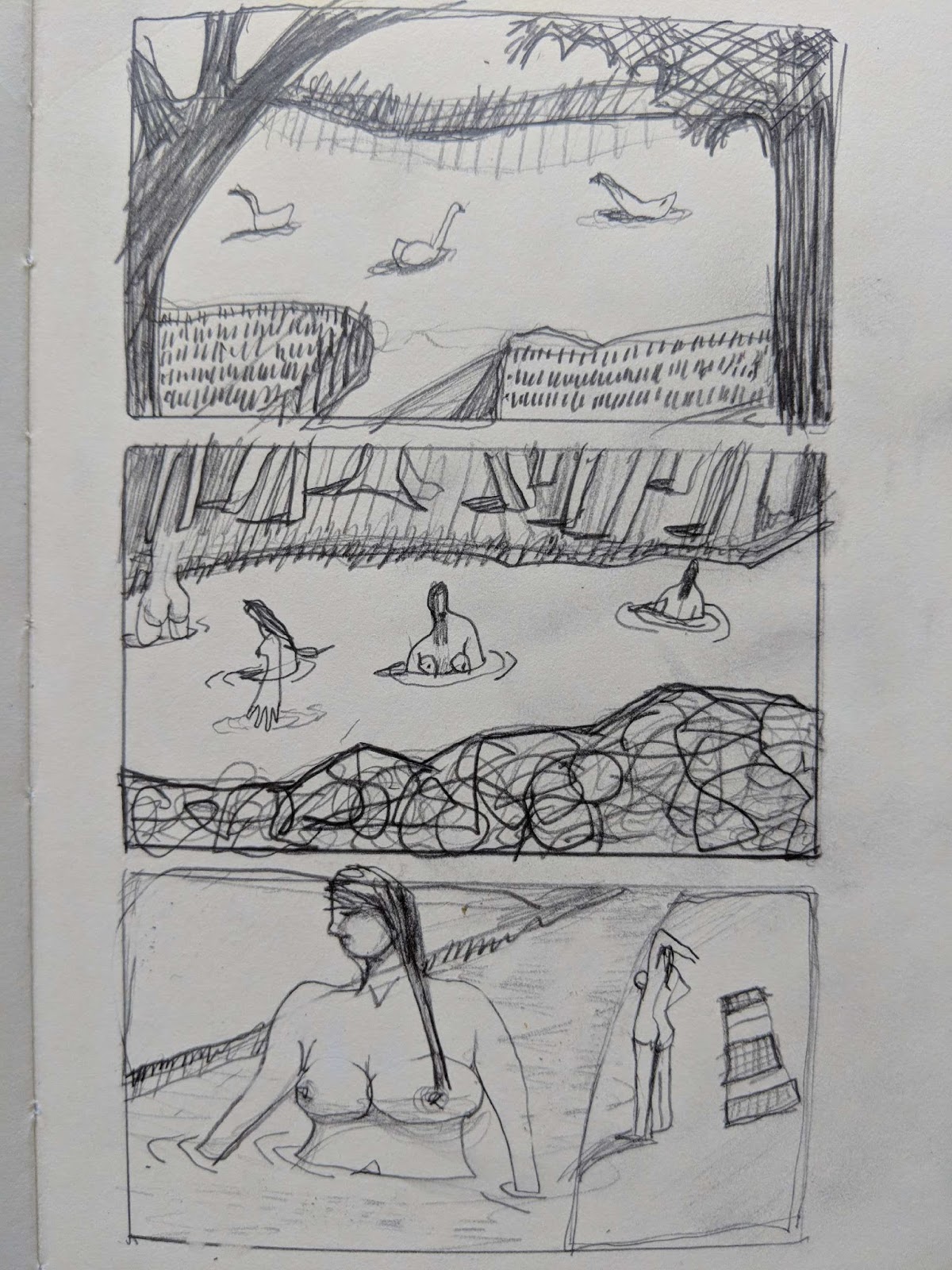
SC: Something in the natural, but muted eroticism of the bathers. Not nude, but just there. The idea of the Venus de Milo in a bikini. It's interesting.

SW: There's something to how open the kimono is...revealing the right amount hiding the best parts. I want to tap into an endless summer atmosphere wherein ghosts are represented as passersby in rivers and lakes and surf. You're always younger when you're swimming and younger is always past. It's a proverbial fish bowl looked on by Prospero. 

SC: Nicely put. Re: Eliot:

Now the hedgerow
Is blanched for an hour with transitory blossom 
Of snow, a bloom more sudden 
Than that of summer, neither budding nor fading, 
Not in the scheme of generation.
Where is the summer, the unimaginable Zero summer?


Shelton Walsmith

Shelton Walsmith


SW: I've continued to study Mark Tansey for his monochromatic mastery and disjointed narrative send offs on sentiment, nostalgia, redacted history and painting about painting. See his "Action paintings"1 and 2. Making grayscale or monochromatic fiction emerges, it's not true to life in it's reduction to tonal over coloristic. My inquiry into how to make it more artificial than lifelike launches a type of Once upon a time...

By grouping them as diptychs or triptychs the additional frame or filmic cell reels another engine of narrative movement


Shelton Walsmith

Shelton Walsmith

SC: Those are excellent. The Muybridge filmic nostalgia.

SW: Like the Disney analogue animation m.o. endless drawings, same but different, not just feeling innocence but also and reanimated call and response btw having it and losing it. Reality vs. recollection. Someone remembered so often their face gets warn off until the memory is grasping as featureless ghosts receding.


Shelton Walsmith


SW: The sexual highlight reel too often revisited goes from lucid real time play by play recollection to blippy gif like compression. Instead of the short film you had now the memory 3 or 4 vignettes flipbooking then it's one long exposure compressed into a single image then  that photograph becomes worn and loses detail to wear and attrition...


Shelton Walsmith

Shelton Walsmith

SC: You are exactly right. Film offers an all too easy metaphor for memory that, while evocative, is not accurate. I think people born in the age of film and now smart phones will think of memory as a message aligned with those mediums: a slow motion panning shot of a walk to the altar, soundtracked with a favorite song, close up on the face, or, far worse, their lives as a series of posed/ not posed filter / no filter selfies. The creative and interpretively demanding windows opened by a work of art with its constantly shifting meanings and aporia are traded for these more compressed representations of the experience - the plastic souvenir remembered instead of the experience itself. The capacities of memory are vast and energized by immersion to the most profound depths. Borges said one of the most signal moments in the development of Western culture was when Aeschylus introduced a second actor onto the stage. No longer a single singer or priest addressing the crowd directly, but a re-presentation of reality, as two actors magically create a dramatic universe we view as non-participatory spectators. No wonder the earliest memory systems were memory theaters. Internal private stages where we each enact our own myths. Something Freud "discovered" as a unexplored country within. 

SW: Isn't interesting that in the first chapter of photography that a negative image needed to be born before it's positive inverse could document the latent image?

A lot of those glass plates that documented Civil War death were destroyed or repurposed as greenhouse windows. It was best forgotten and the photos were a terrible reminder. That reminds me of the Van Gogh scholar researching his haunts and homes discovering a former landlord was using one his paintings traded for rent as the door to her henhouse. The real fate of most pictures rather than d'Orsay, Sotheby's or Hong Kong penthouses.

SC: There is something philosophically and aesthetically beautiful about those images. The eternal question: what is art good for? What does it do? For some, it's a good window, something with which to build a door. Keiffer's monumental leaden books come to mind. But so do the pyramids. And Guernica. 

SW: The use of art or the use of the art encounter is best from the cheap seats in a theatre watching a play. No one's fooling anybody from there and the necessary suspension of disbelief is transferrable into poetry, music and the plastic arts if one needs to ask the question, to what end? Or what use is it?  Suspension of functional practicality. Why take soot or blood and make a handprint or drawing of a bison on the cave wall? To what end? Somehow the question keeps the torch lit. Imaging or reimagining or projecting of mere shadows of the real thing ignites inquiries into the substance of sight and the weight of remembering. Mona Lisa looks at us looking at her and a cycle of wonder loops.

SC: Beautiful. Could my epitaph: 

"To what end? Somehow the question keeps the torch lit. Imaging or reimagining or projecting of mere shadows of the real thing ignites inquiries into the substance of sight and the weight of remembering."

SW: Often progress in art is retrospective like turning your back to the mirror and panning your sightlines back over your shoulder at the view you walking away. Michaelangelo is looking at the ancients and literally thinking, to beat these are guys 

...to beat these guys I need to see  grandeur and monumentality as they saw/projected it. 

Kiefer progressed art by seeing/deposing Nazi hegemony in favor of a pre third Reich Mother Germany. All thru backward visioning. The PreRaphaelite painters pushed into magic realism by genre hopping backward.

SC: Consonant with Borges idea that a writer's awareness of his precursors not only informs his present work, but alters our conception of the past. History is a lie of the mind and as fluid as any story. Thus, he says we now know Homer's Odyssey as coming AFTER Joyce's Ulysses. He cites Whistler's answer to the question of how long it took him to paint one of his nocturnes. Whistler answered, all of my life. "With the same rigor he could have said all the centuries that preceded that moment when he painted were necessary."


Shelton Walsmith


SW: When you answer To what end?  With a political message in visuart at least those aforementioned suspensions become flattened and rigid and to an known end. Political art smells like a doctor's office.

SC: The etymological sense of porno graphia - writing about prostitutes, those who allow themselves to be bought and used for other's purposes. Most of our current culture is pornography to me, more insidious because it tries so desperately to pretend as if it is not. 


Shelton Walsmith


SW: Yeah, we're a mess.

SC: 
Well, I went to the doctor
I said, "I'm feeling kind of rough"
He said, "I'll break it to you, son"
"Let me break it to you, son"
Your shit's fucked up."
I said, "my shit's fucked up?"
Well, I don't see how-"
He said, "The shit that used to work-
It won't work now." - Warren Zevon


Friday, November 29, 2013

This deadly, suffocating, bestial state of fear


The Sacrifice - Andrei Tarkovsky

"Lord, deliver us in this terrible hour. Do not let my children die, my friends, my wife... I will give you all I possess. I will leave the family I love. I shall destroy my home, give up my son. I shall be silent, will never speak with anyone again. I shall give up everything that binds me to life, if You will only let everything be as it was before, as it was this morning, as it was yesterday: so that I may be spared this deadly, suffocating, bestial state of fear."

Thursday, December 20, 2012

The Persistence of Vision: Walk among the tumbled stones


So why return to the intellectual battlefield of a decade ago and walk among the tumbled stones? Because the relationship between film and viewer is important. Not only must the mechanism of persistence of vision that purported to explain the illusion of motion be replaced by an accurate description of the illusion, but the concept of a passive viewer implied by the myth must be replaced by the viewer implied by an enlightened understanding of the illusion: a meaning-seeking creature who engages the film as actively as he engages the real world about him. To reject the mechanism of persistence of vision is to reject the myth of persistence of vision and the passivity of the viewer it implies.
- "The Myth of Persistence of Vision Revisited," Journal of Film and Video, 
Vol. 45, No. 1 (Spring 1993): 3-12. By Joseph and Barbara Anderson.


Hieronymus Bosch, The Garden of Earthly Delights, 1490-1510.


Sunday, June 27, 2010

'Yes' said the rider as white as a bone


The Rider - From the film The Proposition

'When?' said the moon to the stars in the sky
'Soon' said the wind that followed them all

'Who?' said the cloud that started to cry
'Me' said the rider as dry as a bone

'How?' said the sun that melted the ground
and 'Why?' said the river that refused to run

'Where?' said the thunder without a sound
'Here' said the rider and took up his gun

'No' said the stars to the moon in the sky
'No' said the trees that started to moan

'No' said the dust that blunted its eyes
'Yes' said the rider as white as a bone

'No' said the moon that rose from his sleep
'No' said the cry of the dying sun

'No' said the planet as it started to weep
'Yes' said the rider and laid down his gun


From Roger Ebert:

Have you read Blood Meridian, the novel by Cormac McCarthy? This movie comes close to realizing the vision of that dread and despairing story. The critic Harold Bloom believes no other living American novelist has written a book as strong and compares it with Faulkner and Melville, but confesses his first two attempts to read it failed, "because I flinched from the overwhelming carnage."
That book features a character known as the Judge, a tall, bald, remorseless bounty hunter who essentially wants to kill anyone he can, until he dies. His dialogue is peculiar, the speech of an educated man. "The Proposition" has such a character in an outlaw named Arthur Burns, who is much given to poetic quotations. He is played by Danny Huston in a performance of remarkable focus and savagery.

[ source ]


From Blood Meridian:

The judge tilted his great head. The man who believes that the secrets of this world are forever hidden lives in mystery and fear. Superstition will drag him down. The rain will erode the deeds of his life. But that man who sets himself the task of singling out the thread of order from the tapestry will by the decision alone have taken charge of the world and it is only by such taking charge that he will effect a way to dictate the terms of his own fate.

Monday, April 05, 2010

Riddley Walker: Its looking out thru our eye hoals


Saw this years ago. Influential film for me. Russell Hoban's Ridley Walker recalibrated everything:

Lorna said to me, 'You know Riddley theres some thing in us it dont have no name.'

I said, 'What thing is that?'

She said, 'Its some kind of thing it aint us but yet its in us. Its looking out thru our eye hoals. May be you dont take no noatis of it only some times. Say you get woak up suddn in the middl of the nite. 1 minim youre a sleap and the nex youre on your feet with a spear in your han. Wel it wernt you put that spear in your han it wer that other thing whats looking out thru your eye hoals. It aint you nor it don't even know your name. Its in us lorn and loan and sheltering how it can.'

I said, 'If its in every 1 of us theres moren 1 of it theres got to be a manying theres got to be a millying and mor.'

Lorna said, 'Wel there is a millying and mor.'

I said, 'Wel if theres such a manying of it whys it lorn then whys it loan?'

She said, 'Becaws the manying and the millying its all 1 thing it dont have nothing to gether with. You look at lykens on a stoan its all them tiny manyings of it and may be each part of it myt think its sepert only we can see its all 1 thing. Thats how it is with what we are its all 1 girt big thing and divvyt up amongst the many. Its all 1 girt thing bigger nor the worl and lorn and loan and oansome. Tremmering it is and feart. It puts us on like we put on our cloes. Some times we dont fit. Some times it cant fynd the arm hoals and it tears us a part.' [source]

Sunday, December 06, 2009

Life is flesh on bone convulsing above ground


Language bearers, Photographers, Diary Makers,
You with your memory are dead, frozen
Lost in a present that never stoops passing
Here lives the incantation of matter
A language forever.


Like a flame burning away the darkness
Life is flesh on bone convulsing above the ground

- Begotten, E. Elias Merhige. 1991


Begotten is a 1991 Experimental film, directed and written by E. Elias Merhige.

The film heavily deals with religion and the biblical story of the Creation. Its primary inspiration was a near death experience he had when he was 19, after a car crash. The film features no dialogue, but rather uses harsh and uncompromising images of human pain and suffering to tell its tale.

The film was shot on black and white reversal film, and then every frame was rephotographed for the look that is seen. The only colors are black and white. There are no half-tones. This is intended to add to the eerie atmosphere of the movie, as sometimes the viewer cannot always exactly make out what it is being shown, but can still infer a sense of suffering. The look of the film has been described as "a Rorschach test for the eye". For each minute of original film, it took up to 10 hours to rephotograph it for the look desired.

The film opens with a robed, profusely bleeding "God" disemboweling himself, with the act ultimately ending in his death. A woman, Mother Earth, emerges from his remains, arouses the body, and impregnates herself with his semen. Becoming pregnant, she wanders off into a vast and barren landscape. The pregnancy manifests in a fully grown convulsing man whom she leaves to his own devices.

The "Son of Earth" meets a group of faceless nomads who seize him with what is either a very long umbilical cord or a rope. The Son of Earth vomits organic pieces, and the nomads excitedly accept these as gifts. The nomads finally bring the man to a fire and burn him.

"Mother Earth" encounters the resurrected man and comforts him. She seizes the man with a similar umbilical cord. The nomads appear and proceed to rape her. Son of Earth is left to mourn over the lifeless body. A group of characters appears, carry her off and dismember her, later returning for Son of Earth. After he, too, is dismembered, the group buries the remains, planting the parts into the crust of the earth. The burial site becomes lush with flowers.
- Description from lightfox17


The foregoing survey of the custom of publicly expelling the accumulated evils of a village or town or country suggests a few general observations.

In the first place, it will not be disputed that what I have called the immediate and the mediate expulsions of evil are identical in intention; in other words, that whether the evils are conceived of as invisible or as embodied in a material form, is a circumstance entirely subordinate to the main object of the ceremony, which is simply to effect a total clearance of all the ills that have been infesting a people. If any link were wanting to connect the two kinds of expulsion, it would be furnished by such a practice as that of sending the evils away in a litter or a boat. For here, on the one hand, the evils are invisible and intangible; and, on the other hand, there is a visible and tangible vehicle to convey them away. And a scapegoat is nothing more than such a vehicle.

In the second place, when a general clearance of evils is resorted to periodically, the interval between the celebrations of the ceremony is commonly a year, and the time of year when the ceremony takes place usually coincides with some well-marked change of season, such as the beginning or end of winter in the arctic and temperate zones, and the beginning or end of the rainy season in the tropics. The increased mortality which such climatic changes are apt to produce, especially amongst ill-fed, ill-clothed, and ill-housed savages, is set down by primitive man to the agency of demons, who must accordingly be expelled. Hence, in the tropical regions of New Britain and Peru, the devils are or were driven out at the beginning of the rainy season; hence, on the dreary coasts of Baffin Land, they are banished at the approach of the bitter Arctic winter. When a tribe has taken to husbandry, the time for the general expulsion of devils is naturally made to agree with one of the great epochs of the agricultural year, as sowing, or harvest; but, as these epochs themselves naturally coincide with changes of season, it does not follow that the transition from the hunting or pastoral to the agricultural life involves any alteration in the time of celebrating this great annual rite. Some of the agricultural communities of India and the Hindoo Koosh, as we have seen, hold their general clearance of demons at harvest, others at sowing-time. But, at whatever season of the year it is held, the general expulsion of devils commonly marks the beginning of the new year. For, before entering on a new year, people are anxious to rid themselves of the troubles that have harassed them in the past; hence it comes about that in so many communities the beginning of the new year is inaugurated with a solemn and public banishment of evil spirits.

In the third place, it is to be observed that this public and periodic expulsion of devils is commonly preceded or followed by a period of general license, during which the ordinary restraints of society are thrown aside, and all offences, short of the gravest, are allowed to pass unpunished. In Guinea and Tonquin the period of license precedes the public expulsion of demons; and the suspension of the ordinary government in Lhasa previous to the expulsion of the scapegoat is perhaps a relic of a similar period of universal license. Amongst the Hos of India the period of license follows the expulsion of the devil. Amongst the Iroquois it hardly appears whether it preceded or followed the banishment of evils. In In the third place, it is to be observed that this public and periodic expulsion of devils is commonly preceded or followed by a period of general license, during which the ordinary restraints of society are thrown aside, and all offences, short of the gravest, are allowed to pass unpunished. In Guinea and Tonquin the period of license precedes the public expulsion of demons; and the suspension of the ordinary government in Lhasa previous to the expulsion of the scapegoat is perhaps a relic of a similar period of universal license. Amongst the Hos of India the period of license follows the expulsion of the devil. Amongst the Iroquois it hardly appears whether it preceded or followed the banishment of evils. In any case, the extraordinary relaxation of all ordinary rules of conduct on such occasions is doubtless to be explained by the general clearance of evils which precedes or follows it. On the one hand, when a general riddance of evil and absolution from all sin is in immediate prospect, men are encouraged to give the rein to their passions, trusting that the coming ceremony will wipe out the score which they are running up so fast. On the other hand, when the ceremony has just taken place, men’s minds are freed from the oppressive sense, under which they generally labour, of an atmosphere surcharged with devils; and in the first revulsion of joy they overleap the limits commonly imposed by custom and morality. When the ceremony takes place at harvest-time, the elation of feeling which it excites is further stimulated by the state of physical wellbeing produced by an abundant supply of food.

Fourthly, the employment of a divine man or animal as a scapegoat is especially to be noted; indeed, we are here directly concerned with the custom of banishing evils only in so far as these evils are believed to be transferred to a god who is afterwards slain. It may be suspected that the custom of employing a divine man or animal as a public scapegoat is much more widely diffused than appears from the examples cited. For, as has already been pointed out, the custom of killing a god dates from so early a period of human history that in later ages, even when the custom continues to be practised, it is liable to be misinterpreted. The divine character of the animal or man is forgotten, and he comes to be regarded merely as an ordinary victim. This is especially likely to be the case when it is a divine man who is killed. For when a nation becomes civilised, if it does not drop human sacrifices altogether, it at least selects as victims only such wretches as would be put to death at any rate. Thus the killing of a god may sometimes come to be confounded with the execution of a criminal.

If we ask why a dying god should be chosen to take upon himself and carry away the sins and sorrows of the people, it may be suggested that in the practice of using the divinity as a scapegoat we have a combination of two customs which were at one time distinct and independent. On the one hand we have seen that it has been customary to kill the human or animal god in order to save his divine life from being weakened by the inroads of age. On the other hand we have seen that it has been customary to have a general expulsion of evils and sins once a year. Now, if it occurred to people to combine these two customs, the result would be the employment of the dying god as a scapegoat. He was killed, not originally to take away sin, but to save the divine life from the degeneracy of old age; but, since he had to be killed at any rate, people may have thought that they might as well seize the opportunity to lay upon him the burden of their sufferings and sins, in order that he might bear it away with him to the unknown world beyond the grave.

The use of the divinity as a scapegoat clears up the ambiguity which, as we saw, appears to hang about the European folk-custom of “carrying out Death.” Grounds have been shown for believing that in this ceremony the so-called Death was originally the spirit of vegetation, who was annually slain in spring, in order that he might come to life again with all the vigour of youth. But, as I pointed out, there are certain features in the ceremony which are not explicable on this hypothesis alone. Such are the marks of joy with which the effigy of Death. The use of the divinity as a scapegoat clears up the ambiguity which, as we saw, appears to hang about the European folk-custom of “carrying out Death.” Grounds have been shown for believing that in this ceremony the so-called Death was originally the spirit of vegetation, who was annually slain in spring, in order that he might come to life again with all the vigour of youth. But, as I pointed out, there are certain features in the ceremony which are not explicable on this hypothesis alone. Such are the marks of joy with which the effigy of Death is carried out to be buried or burnt, and the fear and abhorrence of it manifested by the bearers. But these features become at once intelligible if we suppose that the Death was not merely the dying god of vegetation, but also a public scapegoat, upon whom were laid all the evils that had afflicted the people during the past year. Joy on such an occasion is natural and appropriate; and if the dying god appears to be the object of that fear and abhorrence which are properly due not to himself, but to the sins and misfortunes with which he is laden, this arises merely from the difficulty of distinguishing, or at least of marking the distinction, between the bearer and the burden. When the burden is of a baleful character, the bearer of it will be feared and shunned just as much as if he were himself instinct with those dangerous properties of which, as it happens, he is only the vehicle. Similarly we have seen that disease-laden and sin-laden boats are dreaded and shunned by East Indian peoples. Again, the view that in these popular customs the Death is a scapegoat as well as a representative of the divine spirit of vegetation derives some support from the circumstance that its expulsion is always celebrated in spring and chiefly by Slavonic peoples. For the Slavonic year began in spring; and thus, in one of its aspects, the ceremony of “carrying out Death” would be an example of the widespread custom of expelling the accumulated evils of the old year before entering on a new one.

- Sir James George Frazer (1854–1941). The Golden Bough. 1922.


Thursday, June 21, 2007

The Photographic Darkroom Where The Reality Photographs Are Actually Produced


The Khronos Projector
"the night as a dark eye in the middle of a luminous sky"


INTERVIEWER
Incidentally, one image in Nova Express keeps coming back to me and I don’t quite understand it: the gray room, “breaking through to the gray room.”

BURROUGHS
I see that as very much like the photographic darkroom where the reality photographs are actually produced. Implicit in Nova Express is a theory that what we call reality is actually a movie. It’s a film, what I call a biologic film. What has happened is that the underground and also the nova police have made a breakthrough past the guards and gotten into the darkroom where the films are processed, where they’re in a position to expose negatives and prevent events from occurring. They’re like police anywhere. All right, you’ve got a bad situation here in which the nova mob is about to blow up the planet. So The Heavy Metal Kid calls in the nova police. Once you get them in there, by God, they begin acting like any police. They’re always an ambivalent agency. I recall once in South America that I complained to the police that a camera had been stolen and they ended up arresting me. I hadn’t registered or something. In other words, once you get them on the scene they really start nosing around. Once the law starts asking questions, there’s no end to it. For nova police, read technology, if you wish.

From The Paris Review Interviews: William Burroughs
PDF of the Interview

Amazon Link: Nova Express by William Burroughs

cf:

Photosynth

"We can do things with the social environment... this is now taking data from everybody... the entire collective memory of visually what the earth looks like... and link all of that together. All of those photos become linked together and they make something emergent that's greater than the sum of the parts."
- Blaise Aguera y Arcas

Thursday, June 09, 2005

Heidegger on Film: The Ister


From the Chronicle of Higher Education:
Time and the River (and Heidegger):
Two Australian filmmakers tour the Danube to unlock the mysteries of one of the 20th century's most influential thinkers

By PETER MONAGHAN

What are viewers to make of a three-hour film about the German philosopher Martin Heidegger (1889-1976) and the legacies of human development along the Danube River, technology, and violent ruptures in recent European history from the Holocaust to the collapse of communism to the breakup of Yugoslavia?

David Barison and Daniel Ross are finding that their 189-minute opus, The Ister (First Run/Icarus Films), has been winning rave reviews and awards in several countries since its debut last year -- including the French Association of Research Cinemas Prize and the Quebec Film Critics' Association Prize. Through its showings at film festivals and conferences, the ambitious project about what the Australian filmmakers describe as "the history of philosophy itself, as it struggles to conceptualize the ideas of existence, lineage, and progress that underpin European civilization's image of itself -- often at the cost of brutal, bloody exclusions" is reinvigorating a conversation among philosophers and historians of ideas as well.

The Ister takes its name from an 1803 poem by Johann Christian Friedrich Hölderlin (1770-1843), about which Heidegger gave a series of lectures in 1942. The poem is among the "hymns" written by Hölderlin to glorify the philosophical legacy of ancient Greece through a mystical meditation on the Danube. (Istros was the river's Greco-Roman name.) In "The Ister," Hölderlin locates sources of natural divinity and community -- as well as the haunting presence of the gods of antiquity -- in the Danube.
via Arts and Letters Daily
Also: From Rouge: The Ister: An Excerpt From Novi Sad to Vukovar

Friday, February 25, 2005

I Keep Remembering This Film That I Forgot


Chris Marker. La Jetée


A film of still images, like Chris Marker's La Jetée, each with a series of captions. Dynamic interplay between the word and the image, each fighting the other for meaning. The film is called Chimage. [ Note: what follows is a sorry re-construction of what I imagine the frames to have been. This does not even evoke the tone of the film. But it provides a fragmentary sense of it - as it resonates in my memory.]


Static interference. White signal, no noise.
Apocalytpic landscapes. A language I can't understand.
She says, "Where do elephants go when they die?"


As each new image is presented time slows down and the meaning sinks in. The imagining of the continuation of the narrative in the next film still/caption is vital and opens up deeper meanings in the current frame.


There beside Arch Stanton, we dug down.
"Is this the one?"
"Deeper. Dig deeper."


But as the film unfolds, as the old images dissolve and the new ones emerge, I forget what the last image was.


Gotterdammerung.
"It is like a dream within a dream."
"Yes," he replied. "But we are not dreaming."


There is only a lingering fog of memory that remains behind. And my frustration to remember is now added to the mystery and beauty of the next part of the film. Indeed, the narrative meaning of the film depends upon it.


"Where do statues go when they die?"
The marble head of a god
falling through my bloody hands
as if they were only tissue.


The still images and words flow by slower and slower and what I have forgotten increases exponentially. The cumulative effect creates a vast space charged with an enormous meaning of what has been forgotten. As the film seems to be coming to its end, I am filled with an aching nostalgia for this unremembered meaning.

The thing is: I saw this film. I remember being there while I watched it. But now there is nothing. And as you begin to question your memory in this way, it all fractals apart into an infinite regression of possibilities.

I ended up doing Google image searches for "chimage" and "chris marker" and various other related terms. What I found were only scattered fragments of the film:


Chris Marker. Silent Movie. 1994-95

Alain Resnais. Night and Fog / Nuit et Brouillard. 1955


Jan Svankmajer. The Ossuary.


But I never found the film itself. Only stills from the films of Chris Marker, Alain Resnais, Jan Svankmajer, Andrei Tarkovski, plus a host of other, seemingly random, images.


However, there are common threads: most of the images have come out of early 20th century Eastern Europe, centered around Czechoslovakia. I believe that whoever made "Chimage" was associated with the above directors, especially Marker, and had direct access to their films. There is also a strange Japanese element in the film. My suspicions are that the filmmaker now lives in Japan. And it is also just a hunch, but I believe he lives there as a fugitive. Perhaps he was associated with the Nazis or one of the oppressive Eastern European regimes. I don't know. That "Chimage" was created out of "stolen" images, I now have no doubt. Maybe this is why I cannot find anything about the film itself on the web, only the stolen fragments that went into its making.

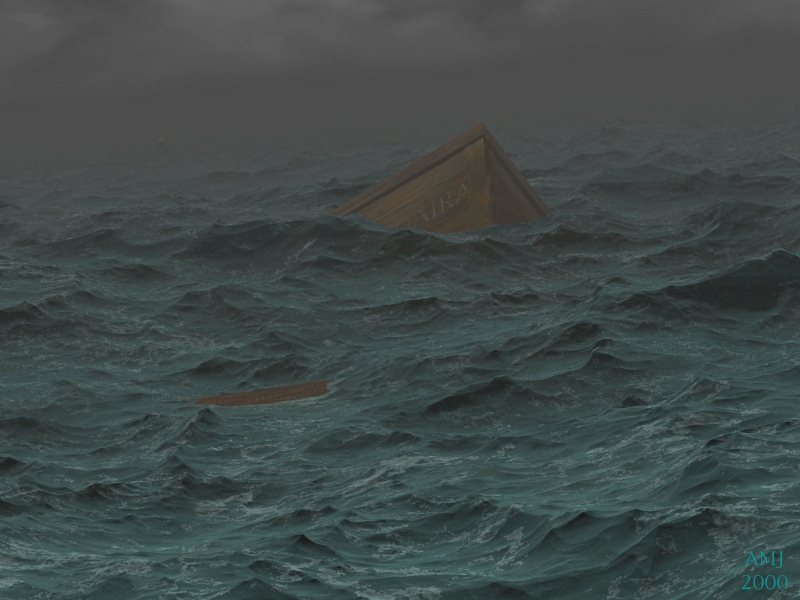
Regardless, none of this explains the curious forgetting effect that "Chimage" has had upon me. My thoughts constantly pick at this "emptiness-full-of-forgetting" within me. I feel like a shipwrecked survivor lost at sea in a lifeboat, gradually coming to the realization that I have amnesia. Bits and pieces of the ship litter the ocean around me, rising periodically to the surface from the sunken ship below. I can't figure out why I am in a boat in the middle of the ocean. Every new fragment of debris that I come across gives me a hint of who and where I am - or was. And the boat is filling up, settling ever deeper into the water.